
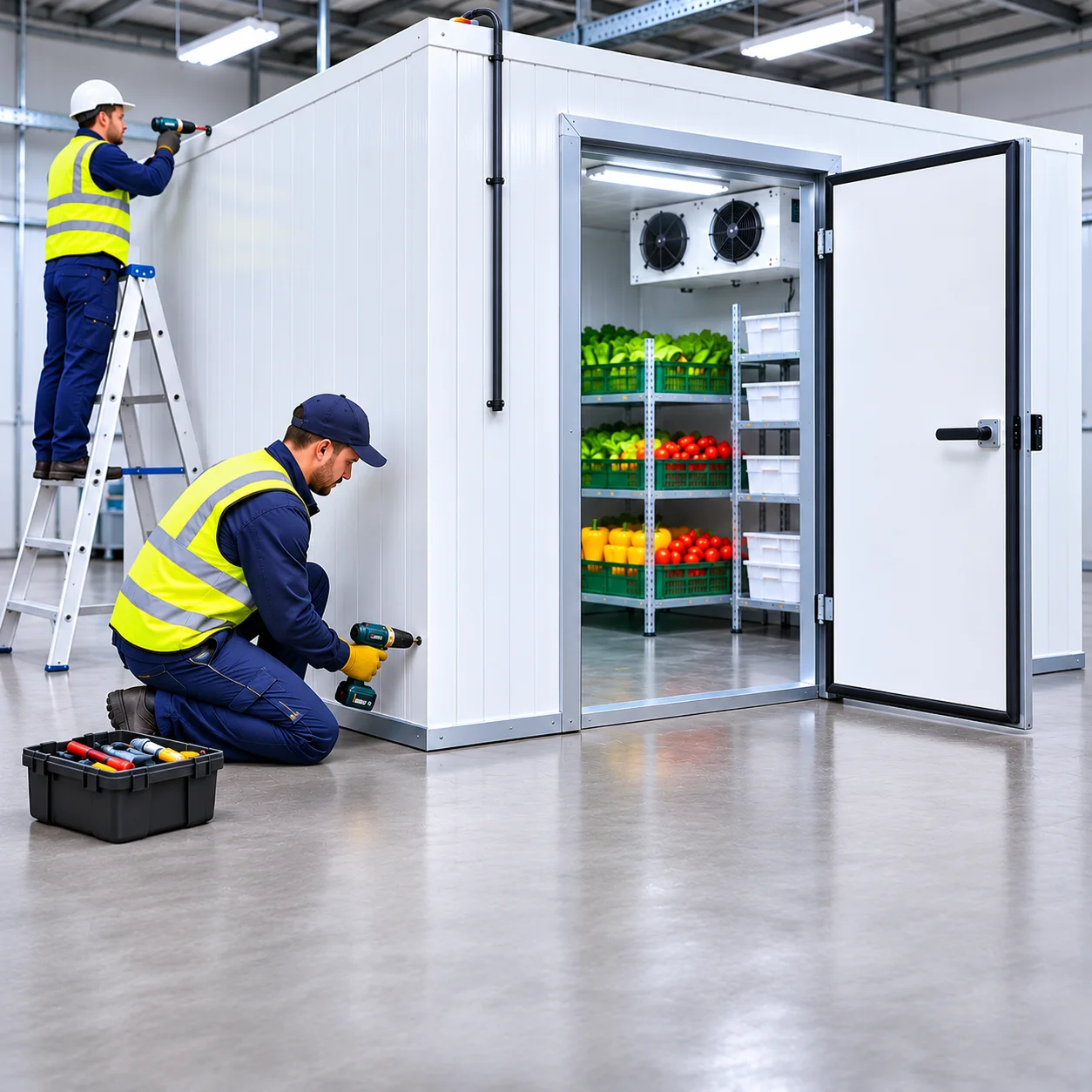
What Is Involved in Installing a Commercial Cold Room in Cambridge?
If you run a restaurant, hotel, food shop, bakery or catering business, reliable refrigeration is essential. A well-designed commercial cold room Cambridge solution gives you the storage space and temperature control needed to protect stock, support food safety and manage busy working days.
However, installing a commercial cold room involves more than fitting insulated panels and connecting a cooling unit. Your building, products, daily deliveries, available power supply and budget all affect the design.
This guide explains the installation process, likely costs, safety requirements and important questions to ask before choosing an installer.
1. Why Cambridge Businesses Need a Commercial Cold Room
Cambridge businesses often need dependable cold storage to manage fresh ingredients, chilled deliveries and larger stock volumes. A walk-in cold room can offer more organised storage than several smaller refrigerators, particularly when staff need frequent access to products.
The right design depends on what you store. A restaurant may need chilled storage for fresh ingredients, while a food manufacturer may require separate chilled and frozen areas. Flowers, specialist products and temperature-sensitive materials can also need carefully controlled conditions.
The Food Standards Agency states that chilled food must generally be kept at 8°C or below in England, Wales and Northern Ireland, with 5°C or below recommended to allow for temperature fluctuations. Your cold room should be designed around the specific products and food safety controls your business uses.
2. What Is Involved in Installing a Commercial Cold Room?
A successful installation starts with understanding how your business operates. According to refrigeration manufacturer Danfoss, room size, product load, target temperature, door-opening frequency and installation location all affect refrigeration system selection.
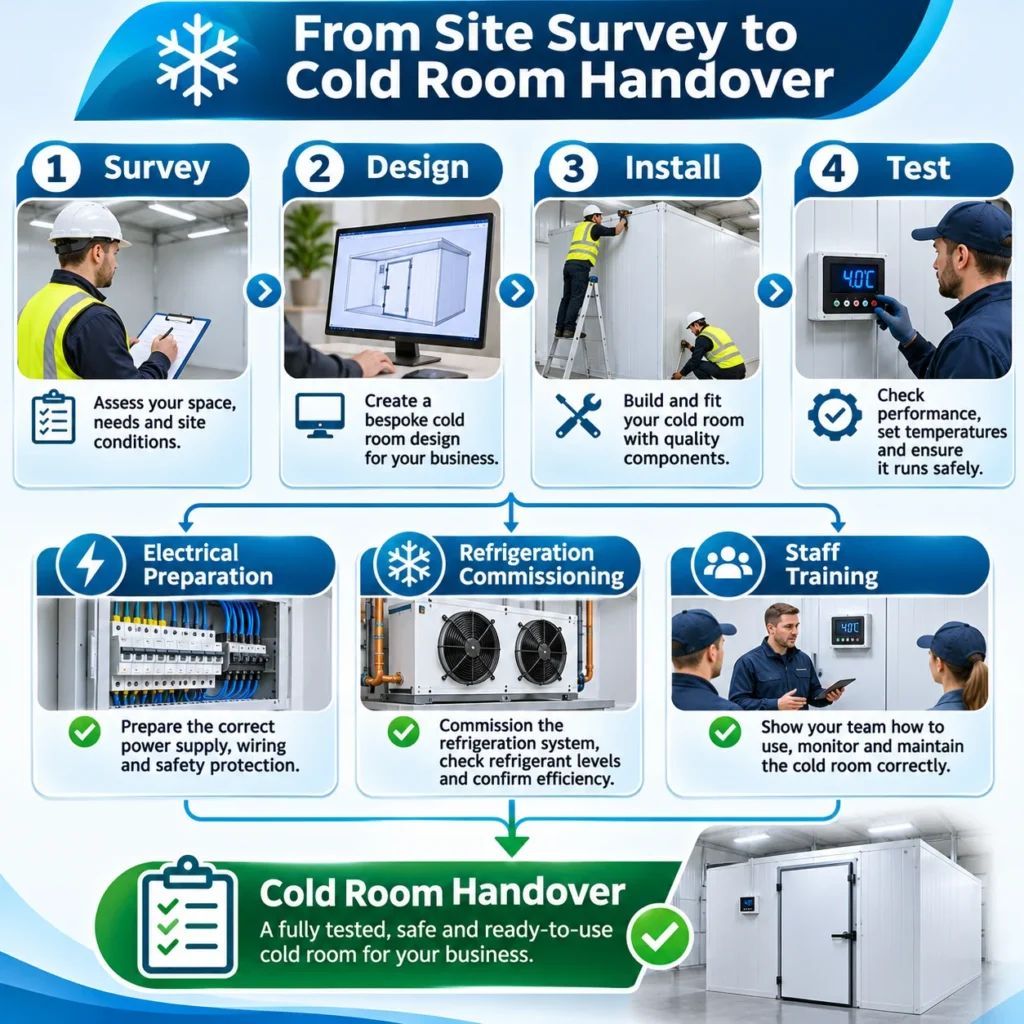
Step 1: Site Survey and Measurements
The installer assesses your premises, measures the available space and checks access for delivering equipment. They also review the floor, electrical supply, drainage requirements, ventilation and the proposed location of the refrigeration unit.
For example, a Cambridge restaurant with a small kitchen may need a compact cold room with carefully planned door access. A food distributor handling frequent deliveries may need a larger room with higher cooling capacity.
Step 2: Cold Room Design
The design specifies the room dimensions, insulated panels, flooring, door, cooling equipment, temperature controls and lighting. The installer should also calculate the refrigeration load rather than choosing equipment based on room size alone.A room that receives frequent deliveries may need more cooling capacity because warm air enters whenever the door opens. Poor insulation and unsuitable equipment can also increase energy consumption.
Step 3: Equipment Delivery and Preparation
Before installation, the team confirms that the equipment can reach the installation area and that the site is ready. Any required building work, electrical preparation and access arrangements should be agreed in advance.
This is also the time to confirm whether the business can continue operating during the work or needs a temporary storage plan.
Step 4: Panel Assembly and Refrigeration Installation
The installers assemble the insulated walls and ceiling, fit the door and floor where required, and seal the joints. They then install the evaporator, condensing unit, pipework, controls and electrical connections.
Freezer rooms need additional attention to insulation and frost management. Danfoss explains that low-temperature designs may require suitable door-frame heating and floor protection to prevent ice formation.
Step 5: Testing and Handover
Once the equipment is installed, the engineer commissions the system and checks that it reaches and maintains the intended temperature. Controls, alarms, door seals, drainage and safe operation should also be checked as applicable.
Before accepting the installation, ask for operating instructions, warranty details, service information and relevant refrigeration records. Staff should understand how to monitor temperatures and respond to an alarm.
3. How Much Does Commercial Cold Room Installation Cost?
The cost of a commercial cold room depends on its dimensions, operating temperature, insulation, refrigeration equipment and the work needed to prepare your premises. A simple installation in a ready-to-use space will usually involve fewer complications than a bespoke room requiring electrical upgrades or building alterations
Installation factor | How it affects the cost |
Room size | Larger rooms require more panels and cooling capacity. |
Chiller or freezer | Freezer systems need suitable low-temperature equipment and insulation. |
Site preparation | Electrical work, flooring and drainage can add costs. |
Refrigeration system | Equipment type, controls and monitoring affect the final price. |
Access and installation | Restricted access or complex pipework may increase labour costs. |
Treat any online price as an initial guide rather than a confirmed quotation. Ask for a written breakdown covering equipment, delivery, installation, commissioning, warranties and any excluded work.
For an accurate estimate, arrange a site survey before committing to a design. This helps identify additional costs early and reduces the risk of unexpected changes during installation.
4. Safety, Regulations and Energy Efficiency
A commercial cold room must do more than keep products cold. It should provide a safe working environment, support the business’s food safety procedures and use suitable refrigeration equipment.
Check F-Gas Qualifications
Where the refrigeration system contains fluorinated greenhouse gases (F-gases), the relevant installation work must be carried out by appropriately qualified personnel. Companies undertaking covered work on equipment operated by other businesses must also hold the required company certification.
The UK government’s F-Gas qualification guidance explains the applicable requirements. Ask the installer to confirm which qualifications and company certifications apply to your proposed system.
Make Safe Access a Priority
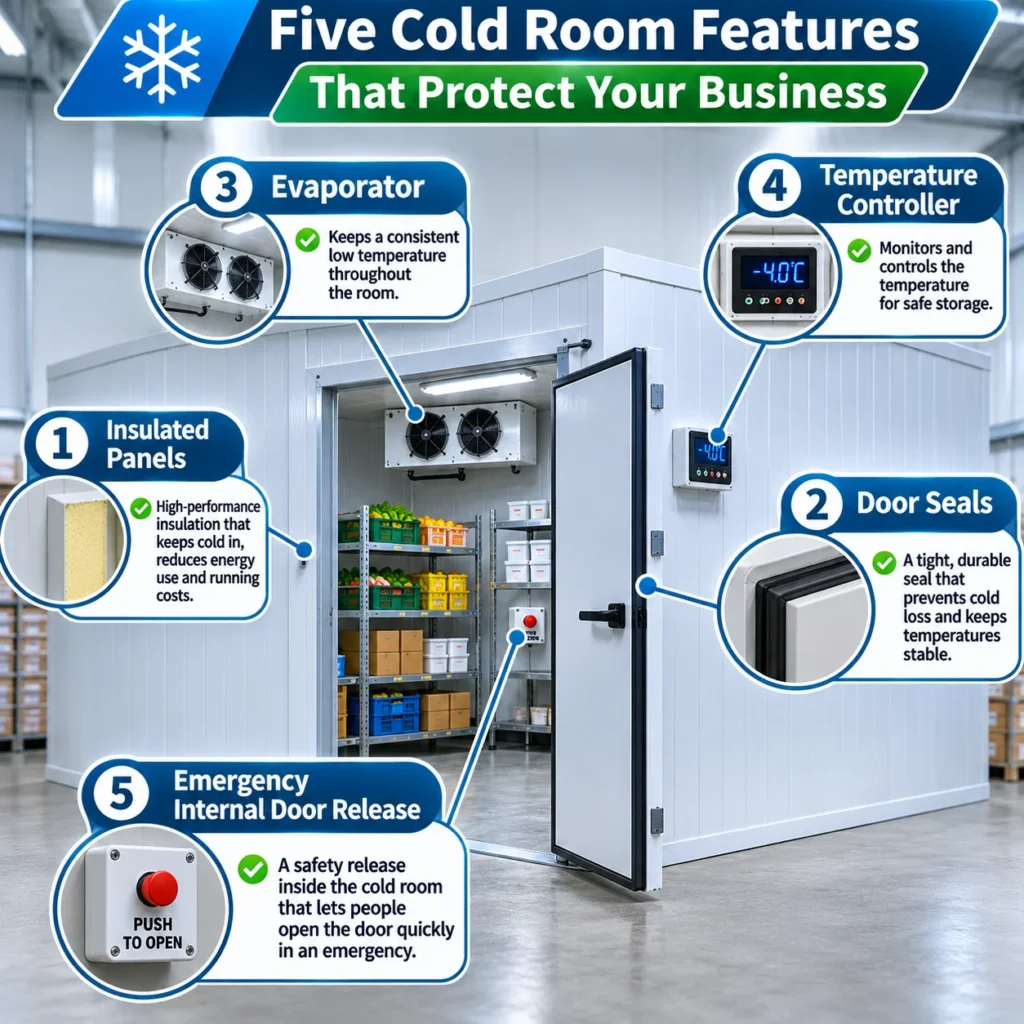
Staff must be able to enter and leave the room safely. The Health and Safety Executive advises that walk-in refrigeration rooms and freezers need doors that can be opened from inside, with lighting or another means of locating the opening device when the door is closed. A risk assessment may also identify the need for a trapped-person alarm.
Reduce Unnecessary Energy Use
Choose well-sealed insulated panels, correctly sized refrigeration equipment and effective temperature controls. Keep the condenser adequately ventilated, minimise unnecessary door openings and arrange maintenance according to the manufacturer’s instructions.
A properly designed system can help avoid wasted energy, but actual savings depend on the equipment, usage patterns and the conditions at your premises.
5. How to Choose the Right Cold Room Installer
Choosing an installer on price alone can be costly if the equipment is poorly matched to your business. Look for relevant commercial refrigeration experience, applicable F-Gas credentials, clear quotations and dependable aftercare.
Ask whether the proposed system suits your products, how temperatures will be monitored, what happens if the equipment fails and how quickly replacement parts can be obtained. You should also confirm the warranty, planned maintenance arrangements and any emergency support available.
Before signing, make sure you understand what is included, when the work will be completed and who is responsible for testing the system.
Planning a new cold room in Cambridge? What products do you need to store, how much space do you have, and what temperature must the room maintain? Sharing these details with a suitable installer is a useful first step towards an accurate quotation.
Frequently Asked Questions
1. How long does commercial cold room installation take?
A small, straightforward installation may take one to two days, while larger or more complex projects can take several days or longer. The actual schedule depends on site preparation, equipment availability, room size and commissioning requirements.
2. How much does a commercial cold room cost in Cambridge?
The price depends on room dimensions, temperature requirements, refrigeration equipment and installation work. Request a site survey and an itemised quotation to understand the likely total cost for your premises.
3. What temperature should a commercial cold room maintain?
For chilled food, the Food Standards Agency recommends keeping refrigerators at 5°C or below, although the legal limit for many chilled foods in England is 8°C. Frozen products and specialist goods require different conditions, so confirm the correct range for your stock.
4. Do I need an F-Gas-certified installer?
Where the installation involves regulated work on equipment containing F-gases, the relevant personnel must have the required qualifications. Companies carrying out covered work on equipment operated by other businesses must also have the applicable certification.
5. Can a commercial cold room be installed in an existing building?
Yes, provided the building has suitable space and the necessary structural, electrical and refrigeration arrangements. A site survey helps identify access restrictions, ventilation needs and any alterations required.
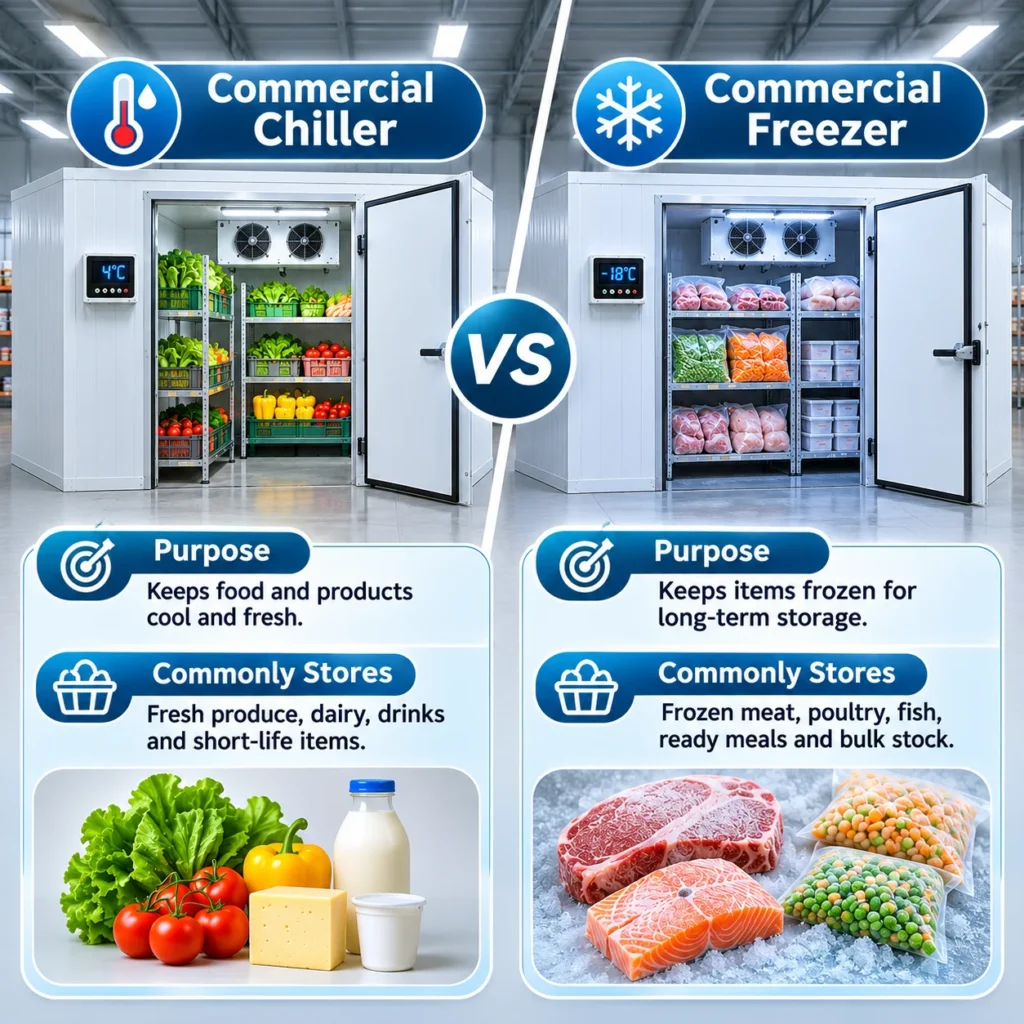
6. What is the difference between a chiller and a freezer room?
A chiller maintains temperatures suitable for chilled products, while a freezer operates at much lower temperatures for frozen storage. Freezer rooms generally need different refrigeration equipment, insulation and frost-management measures.
7. Can a commercial cold room be customised?
Yes, cold rooms can be designed around available space, product types, storage capacity and working routines. The design should also account for door positions, shelving, delivery patterns and the required temperature range.
8. How can I reduce commercial cold room running costs?
Good insulation, effective door seals, suitable equipment sizing and regular maintenance can help reduce energy waste. Limiting unnecessary door openings and keeping condenser areas clear can also support efficient operation.
9. How often should a commercial cold room be serviced?
The service schedule depends on the equipment, operating conditions and manufacturer’s instructions. Planned professional maintenance, combined with regular temperature checks, helps identify developing faults before they cause a major disruption.
10. What should I check before accepting a new cold room installation?
Confirm that the system reaches its specified temperature and that the controls, alarms, doors and refrigeration equipment operate correctly. Obtain the operating instructions, warranty details, relevant compliance records and maintenance recommendations before signing off the work.