
Need Refrigeration Maintenance in Leeds? Book a Free Site Survey
If your business depends on cold rooms, commercial fridges, freezers or other temperature-controlled equipment, refrigeration maintenance Leeds services can be one of the simplest ways to reduce unexpected downtime and protect valuable stock. A refrigeration system can appear to be working normally while gradually becoming less efficient, developing a refrigerant leak or putting excessive strain on its compressor.
For restaurants, supermarkets, food manufacturers, warehouses, hospitality businesses and other commercial premises, a refrigeration failure can quickly become a business problem rather than simply an engineering problem. Lost stock, interrupted operations and food-safety concerns can all follow a poorly maintained system.
The good news is that many developing faults can be identified during planned servicing, before they become an emergency.
Why Refrigeration Maintenance Matters for Leeds Businesses
Commercial refrigeration operates for long periods and is often exposed to demanding conditions. Condenser coils collect dust, fans wear, door seals deteriorate, sensors can become inaccurate and electrical components can develop faults.
A maintenance visit should therefore involve more than simply checking whether the unit is cold.
A competent engineer should assess the system’s overall operating condition, identify abnormal readings and look for evidence of wear or developing faults. The objective is preventative: find the problem while it is still manageable.
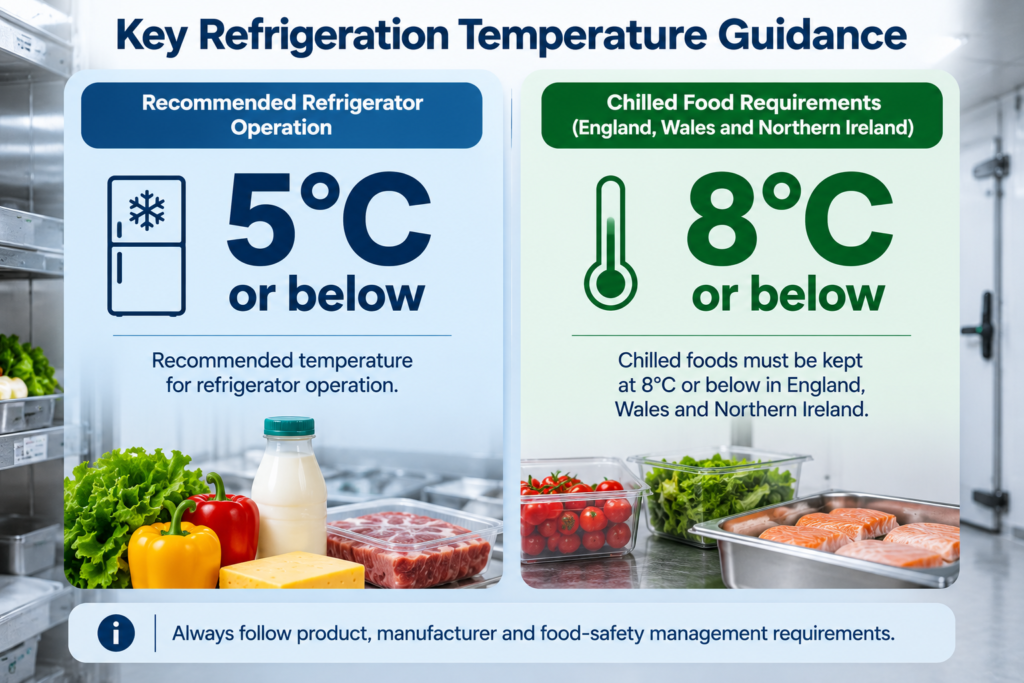
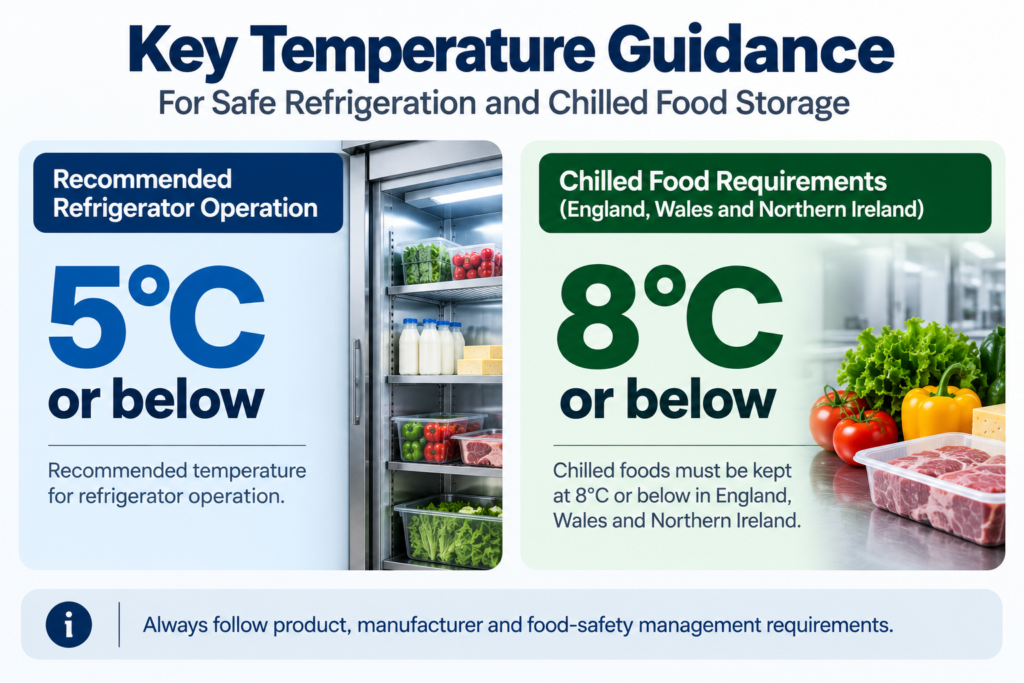
This is particularly important for food businesses. The Food Standards Agency recommends that refrigerators operate at 5°C or below, while cold food in England, Wales and Northern Ireland must generally be kept at 8°C or below.
What Professional Refrigeration Maintenance Includes
A proper service should examine the refrigeration system as a complete working system rather than focusing on one component.
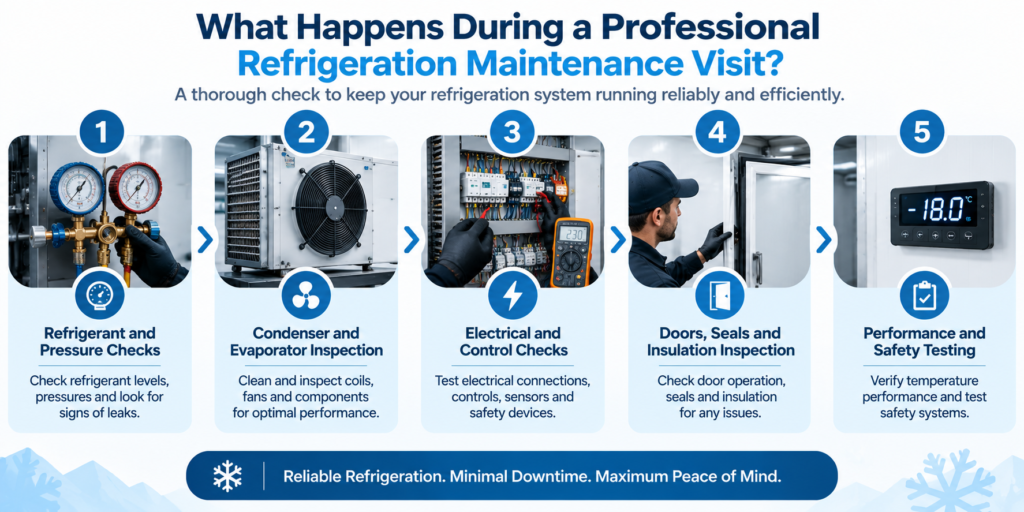
Refrigerant and Pressure Checks
Refrigerant charge and operating pressures affect cooling performance. An abnormal reading can indicate a leak, restriction, component problem or another underlying fault.
Engineers should investigate the cause rather than simply adding refrigerant and leaving the system running.
Condenser and Evaporator Inspection
Dirty condenser coils can restrict heat rejection and make the refrigeration system work harder. Evaporators also need attention because ice accumulation, restricted airflow or poor defrost performance can affect temperature stability.
Fans, guards and airflow paths should be inspected as part of the same process.
Electrical and Control Checks
Contactors, wiring, sensors, controllers and other electrical components influence how accurately the system responds to temperature demand.
Temperature verification is especially important because a display reading does not automatically prove that stored products are being maintained at the correct temperature.
Doors, Seals and Insulation
A damaged door gasket or poorly closing cold-room door can allow warm air into the refrigerated space repeatedly. The refrigeration system then has to remove that additional heat.
For cold rooms, engineers should also consider the condition of panels, insulation, doors and other areas that could compromise temperature retention.
Performance and Safety Testing
Professional servicing should finish with an assessment of whether the system is operating within appropriate parameters and whether any recommended corrective work is necessary.
Coldroomplus describes its maintenance process as covering refrigerant checks, superheat and subcooling calculations, compressor electrical readings, temperature verification, controls, condenser cleaning and evaporator airflow.
Preventative Maintenance vs Emergency Repair
There is an important difference between refrigeration maintenance and refrigeration repair Leeds businesses may need after a breakdown.
| Preventative Maintenance | Reactive Repair |
|---|---|
| Planned before failure | Usually triggered by a fault |
| Identifies developing problems | Responds to an existing problem |
| Helps reduce unexpected downtime | Aims to restore operation |
| Allows work to be scheduled | Can require urgent attendance |
| Supports predictable maintenance costs | Costs can become harder to predict |
Preventative Maintenance
- Planned before failure
- Identifies developing problems
- Helps reduce unexpected downtime
- Allows work to be scheduled
- Supports predictable maintenance costs
Emergency Repair
- Usually triggered by a fault
- Responds to an existing problem
- Aims to restore operation
- Can require urgent attendance
- Costs can become harder to predict
Preventative Maintenance
- Planned before failure
- Identifies developing problems
- Helps reduce unexpected downtime
- Allows work to be scheduled
- Supports predictable maintenance costs
Emergency Repair
- Usually triggered by a fault
- Responds to an existing problem
- Aims to restore operation
- Can require urgent attendance
- Costs can become harder to predict
Neither approach eliminates the need for the other. Even a well-maintained refrigeration system can fail.
However, relying entirely on emergency repairs means problems are often discovered at the worst possible time: during busy service periods, overnight, or when the equipment is holding valuable stock.
A sensible strategy combines scheduled preventative maintenance with access to emergency support when something unexpected happens.
Choosing the Right Refrigeration Engineer
The right contractor should understand both refrigeration engineering and the commercial consequences of equipment failure.
Before appointing a provider, check whether the engineers have appropriate RACHP and F-Gas qualifications for the work involved. The UK Government specifically identifies qualifications for installation, servicing, maintenance, leak checking and refrigerant recovery activities.
It is also worth asking whether the contractor works with your type of equipment, provides written service reports, uses appropriate genuine replacement components and can offer emergency support if a failure occurs.
Experience matters too. A technically competent engineer should be interested in why the system is behaving differently, not simply which part can be replaced.
Practical Maintenance Tips for Businesses
Your engineering contractor handles technical servicing, but your staff can help protect the equipment between visits.
Keep condenser areas clear and avoid storing materials where they restrict ventilation. Keep cold-room doors closed when they are not being used and report damaged seals promptly.
Record refrigeration temperatures according to your food-safety procedures and investigate abnormal readings rather than assuming they are temporary. The FSA recommends daily fridge temperature checks for food businesses as part of good practice.
Do not attempt refrigerant work yourself. F-Gas-related activities should be carried out by appropriately qualified personnel.
Most importantly, don’t wait for a complete breakdown before reporting unusual noises, temperature fluctuations or repeated alarms.
Is your refrigeration equipment in Leeds due for a professional service, or are you already noticing temperature fluctuations, unusual noises or rising running costs? A free site survey can help identify what needs attention before a small issue becomes an expensive breakdown.
Frequently Asked Questions
1. What does commercial refrigeration maintenance include?
Commercial refrigeration maintenance normally involves inspecting refrigeration components, controls, electrical systems, airflow, temperature performance and refrigerant-related conditions. The exact scope should be adapted to the equipment, operating environment and manufacturer’s requirements.
2. How often should commercial refrigeration be serviced?
The appropriate interval depends on equipment type, usage, age and operating conditions. High-demand commercial environments may require more frequent servicing than lightly used equipment, so a site-specific maintenance schedule is preferable to a one-size-fits-all approach.
3. What temperature should a commercial fridge be?
The FSA recommends keeping refrigerators at 5°C or below as good practice. For food businesses in England, Wales and Northern Ireland, chilled food generally must be kept at or below 8°C, subject to applicable requirements and specific circumstances.
4. What are the signs that a commercial refrigerator needs repair?
Common warning signs include temperature fluctuations, excessive ice, unusual noises, prolonged cooling cycles, repeated alarms and visible water leaks. Increasing energy consumption can also indicate that equipment is operating inefficiently.
5. Is refrigeration maintenance better than waiting for a breakdown?
Preventative maintenance can identify developing faults before they become major failures. It does not eliminate breakdowns completely, but it can make refrigeration problems more predictable and reduce the risk of disruptive emergency failures.
6. Do refrigeration systems need F-Gas leak checks?
Some refrigeration equipment containing F-gases is subject to mandatory leak-check requirements based on the refrigerant’s CO₂ equivalent and other factors. Businesses should establish the applicable requirements for each qualifying system and maintain the required records.
7. Can a refrigeration engineer simply add more refrigerant?
Adding refrigerant without investigating why the charge is low may only mask an underlying problem. Where a leak exists, the appropriate response is to identify and repair it and complete the required follow-up checks.
8. Does cleaning refrigeration equipment improve efficiency?
Cleaning components such as condenser coils and maintaining unrestricted airflow can support effective heat rejection. However, efficiency also depends on refrigerant conditions, controls, fans, compressors, insulation and other system factors.
9. Should old commercial refrigeration equipment be repaired or replaced?
That depends on the equipment’s condition, repair history, efficiency, refrigerant considerations and expected future operating costs. A professional assessment can help compare the cost and risk of continued repairs against modernisation or replacement.
10. Why should businesses use qualified refrigeration technicians?
Refrigeration work can involve refrigerants, electrical components, pressure systems and food-safety considerations. UK government guidance requires appropriate qualifications for specified F-Gas activities and company certification for businesses servicing qualifying stationary equipment operated by others.