
24/7 Commercial Refrigeration Repair: What to Do When Your System Fails
When a commercial refrigerator, freezer or cold room suddenly stops working, commercial refrigeration repair becomes a business-critical issue rather than a routine maintenance task. A failed system can threaten stock, interrupt production, affect customer service and create serious food-safety concerns within a surprisingly short period.
The first priority is not simply getting the compressor running again. It is protecting products, controlling temperatures, identifying the underlying fault and restoring the system safely.
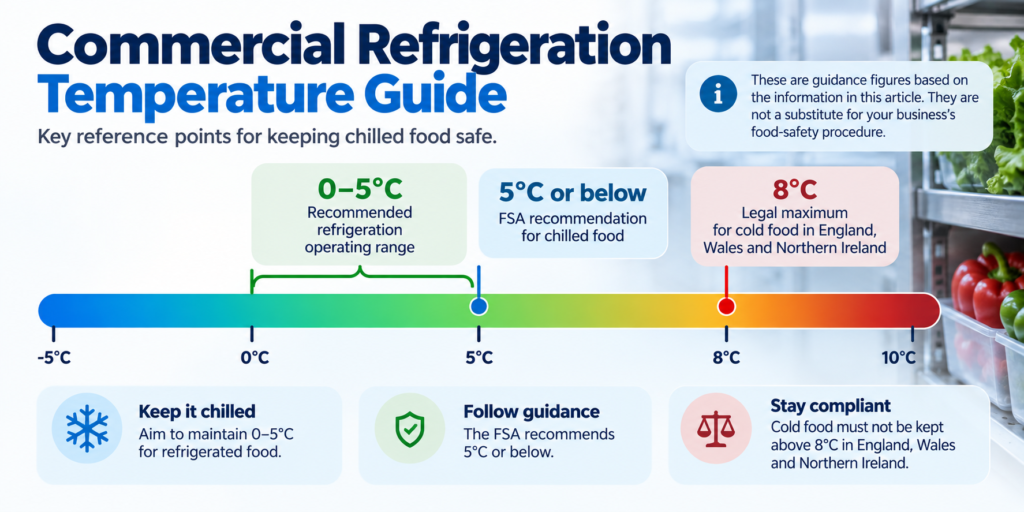
The Food Standards Agency recommends that food businesses routinely monitor refrigeration temperatures, with chilled food generally maintained at or below 8°C and 0–5°C regarded as the recommended operating range for refrigeration.
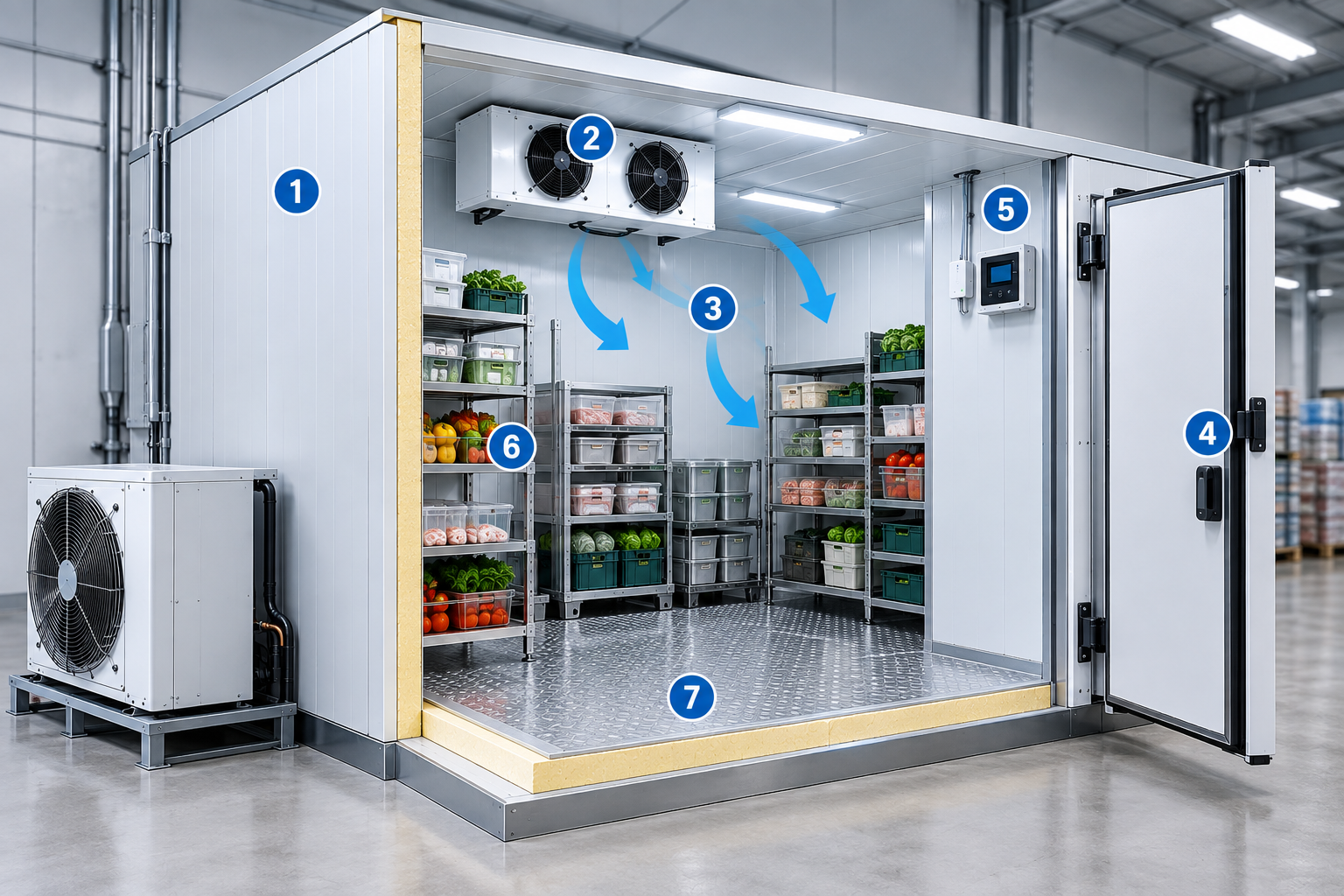
For restaurants, hotels, supermarkets, caterers, food manufacturers and other commercial operations, selecting the wrong refrigeration system can lead to wasted energy, damaged stock and unreliable temperature control. Danfoss notes that cold-room design depends on factors including stored products, door-opening frequency, target temperature and the amount of warm product being introduced.
What Should You Do Immediately After a Refrigeration Failure?
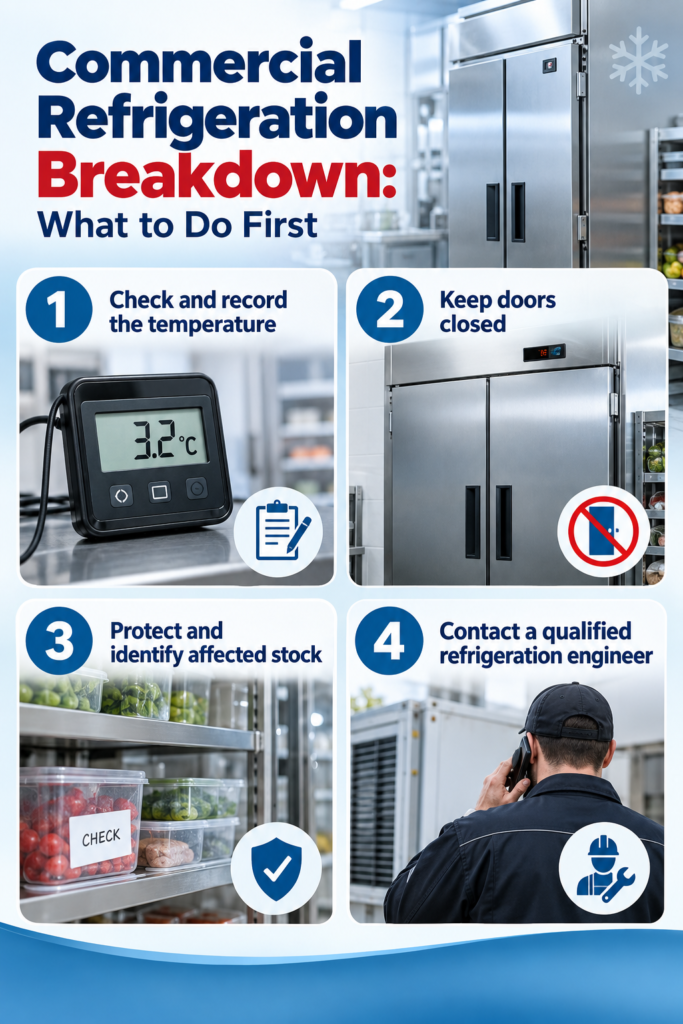
Stay calm and avoid repeatedly switching a failed system on and off. Record the current temperature, note when the problem was discovered and keep the doors closed as much as possible.
Next, check whether the failure affects one cabinet or the wider refrigeration system. A single warm display cabinet may have a local fault, whereas several units losing temperature could indicate an electrical, control or plant-room problem.
If the equipment has a temperature alarm or remote monitoring system, check its readings and notifications. This information can be extremely useful to the engineer because it establishes when the temperature started changing.
Do not attempt to dismantle refrigeration components or interfere with refrigerant circuits. Refrigeration systems can contain pressurised gases, and the Health and Safety Executive identifies refrigeration plants among pressure systems requiring appropriate safety controls and competent maintenance.
Key takeaway: Protect the stock first, preserve temperature records and arrange professional diagnosis as quickly as possible.
The Most Common Causes of Commercial Refrigeration Breakdown
Not every refrigeration failure means the compressor has failed. Several relatively small problems can cause significant temperature instability.
A dirty condenser can restrict heat rejection and make the system work harder. Damaged door seals can allow warm air into a cold room, while blocked airflow or excessive ice can interfere with heat transfer.
Other common faults include failed fan motors, defective sensors, electrical problems, control-board faults, refrigerant leaks and defrost-system failures. Coldroomplus‘s current refrigeration maintenance service similarly identifies compressor, refrigerant, fan, control, defrost, electrical and temperature faults among the issues requiring professional diagnosis.
| Symptom | Possible cause | Typical priority |
|---|---|---|
| Cabinet becoming warm | Airflow, sensor, refrigerant or compressor issue | High |
| Heavy ice formation | Defrost or airflow fault | High |
| Compressor constantly running | Dirty condenser, poor airflow or refrigerant problem | High |
| Unusual electrical noise | Fan, motor or electrical fault | High |
| Temperature fluctuating | Sensor, controls, door seal or refrigerant issue | High |
| Water around equipment | Drain or defrost problem | Medium to high |
These symptoms should not automatically be treated as the diagnosis. A qualified engineer needs to test the system and establish the actual cause.
When Is a Refrigeration Failure an Emergency?
A refrigeration failure should be treated as urgent when perishable stock is at risk, temperatures are rising, a freezer is defrosting, a cold room is critical to production, or the equipment is showing signs of electrical or mechanical danger.
For food businesses, the consequences extend beyond lost stock. Temperature records, food-safety procedures and the ability to demonstrate appropriate controls can all become important when equipment fails.
The FSA‘s research found that daily temperature-checking routines are important for food businesses and that businesses need to act when refrigeration temperatures rise above their recommended operating range.
For that reason, waiting several hours to see whether a struggling refrigeration unit “recovers” can be a costly gamble.
What Can You Check Before the Engineer Arrives?
There are a few safe observations that can help without attempting a repair.
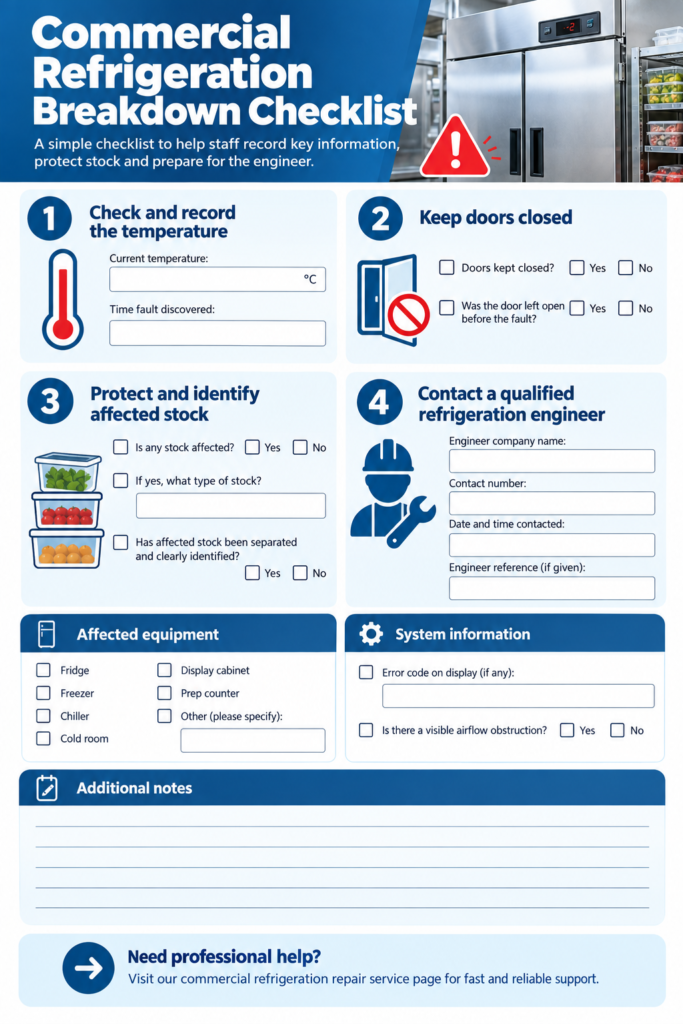
Check whether the equipment has electrical power and whether other nearby equipment is operating normally. Look at the display for error codes and check whether doors are closing correctly.
Inspect the visible condition of door seals and make sure vents have not been obstructed by stock. If safe to do so, check whether the condenser area appears heavily contaminated with dust or debris.
Record temperatures at regular intervals and keep the refrigeration doors closed as much as practical.
Do not remove electrical covers, release refrigerant, bypass safety controls or attempt to recharge the system yourself. The UK Government requires individuals working on relevant F-Gas equipment to hold appropriate qualifications, while companies servicing stationary F-Gas equipment for other businesses require certification.
Food Safety During a Refrigeration Breakdown
This is often the most important part of the incident.
If chilled food has been exposed to temperatures outside your approved food-safety limits, do not rely on smell or appearance to determine whether it is safe. Follow your documented food-safety procedure and applicable FSA guidance.
The FSA recommends refrigeration at 5°C or below and explains that food businesses in England, Wales and Northern Ireland are legally required to keep cold food below 8°C.
Maintain temperature records, identify affected stock and document what action was taken. Depending on the type of food, exposure time and your food-safety management system, products may need to be discarded.
This is one reason rapid commercial refrigeration repair is about much more than convenience: it can help reduce stock losses while supporting safe business operations.
Repair or Replace: Which Makes Financial Sense?
Repair is usually attractive when the equipment is fundamentally sound and the failed component can be replaced economically.
Replacement deserves consideration when equipment is repeatedly failing, becoming inefficient, uses obsolete components or has reached the point where repair costs approach the value of a newer, more efficient system.
The Carbon Trust notes that refrigeration can represent a substantial share of energy consumption across businesses and that improving efficiency can reduce both energy costs and breakdown risk. Its refrigeration guidance specifically covers compressors, condensers, evaporators, cold rooms, controls and refrigerant leakage.
| Situation | Usually worth considering |
|---|---|
| Isolated component failure | Repair |
| Equipment otherwise reliable | Repair and maintain |
| Frequent repeated failures | Repair cost analysis |
| Poor energy performance | Upgrade assessment |
| Obsolete equipment or unavailable parts | Replacement |
| Expanding business requirements | New engineered system |
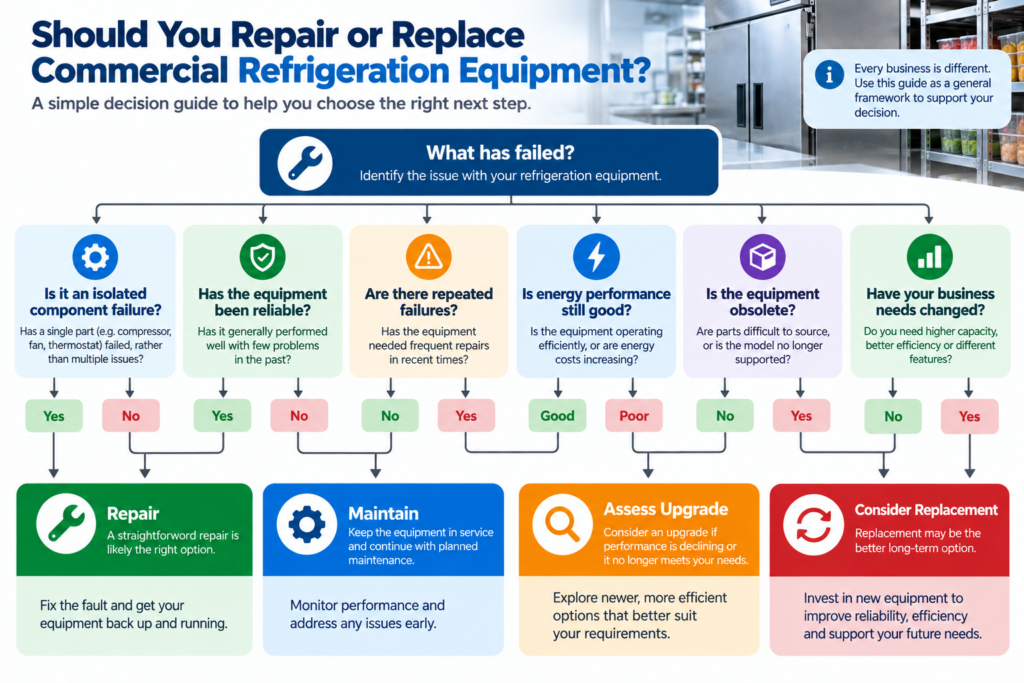
A good engineer should explain the options rather than automatically recommending replacement.
How Preventative Maintenance Reduces Breakdown Risk
Emergency repair is reactive. Preventative maintenance is about finding weaknesses before they become emergencies.
A professional maintenance programme can include inspection of compressors, condensers, evaporators, fans, controls, electrical components, refrigerant performance, door seals, drainage and temperature stability.
Cleaning coils and maintaining airflow are particularly important because refrigeration equipment has to reject and absorb heat effectively. The Carbon Trust also recommends attention to condenser and evaporator cleanliness, door seals, defrost procedures and correct refrigerant charge.
Maintenance frequency should reflect the equipment, environment and workload. A busy food-production cold room operating continuously may require a different maintenance strategy from a lightly used commercial cabinet.
Modern monitoring can add another layer of protection. Remote temperature monitoring and predictive maintenance technologies can identify abnormal conditions earlier, potentially allowing intervention before a complete failure occurs.
If your commercial refrigeration system failed tonight, would you know exactly what to check, how to protect your stock and when to call for professional commercial refrigeration repair?
Frequently Asked Questions About Commercial Refrigeration Repair
1. How quickly should a commercial refrigerator be repaired?
A refrigeration failure should be assessed promptly when it threatens food, pharmaceuticals, production or other temperature-sensitive stock. The longer temperatures remain outside the required range, the greater the potential for product loss and operational disruption.
2. What causes a commercial refrigerator to stop cooling?
Common causes include compressor faults, condenser or evaporator airflow problems, fan failures, refrigerant leaks, defective sensors, electrical faults and defrost problems. The visible symptom does not always identify the failed component, so professional diagnosis is important.
3. How often should commercial refrigeration equipment be serviced?
There is no single interval suitable for every business because operating hours, equipment type, environment and workload differ. A suitable preventative-maintenance programme should be based on the manufacturer’s requirements and the risks associated with the individual installation.
4. Can a commercial fridge still operate with a damaged door seal?
It may continue operating, but a damaged seal can allow warm air and moisture into the cabinet. This can increase energy consumption, encourage ice formation and make temperature control more difficult.
5. What temperature should a commercial refrigerator be?
The FSA recommends keeping refrigeration at 5°C or below, while chilled food in England, Wales and Northern Ireland must generally be kept below the legal maximum of 8°C. Businesses should follow the requirements applicable to their specific food-safety procedures and products.
6. Can staff repair a refrigerant leak themselves?
Refrigerant-circuit work should be carried out by appropriately qualified personnel. GOV.UK requires relevant qualifications for activities such as leak checking, servicing, refrigerant recovery and maintenance of applicable F-Gas refrigeration equipment.
7. Is commercial refrigeration repair cheaper than replacing equipment?
It depends on the equipment’s age, condition, efficiency, repair history and availability of parts. A relatively minor component failure can make repair sensible, while repeated breakdowns and poor efficiency may justify assessing replacement.
8. Why does a commercial freezer keep building up ice?
Ice accumulation can result from defrost-system faults, poor door sealing, excessive moisture, airflow restrictions or other refrigeration problems. Continued operation without addressing the underlying cause can reduce cooling performance and increase energy use.
9. What should I do with food during a refrigeration breakdown?
Keep doors closed, monitor and document temperatures, separate potentially affected stock and follow your food-safety management procedure. Do not assume food is safe simply because it looks or smells normal.
10. Does preventative maintenance really reduce refrigeration costs?
Yes, maintenance can help identify faults early, preserve efficiency and reduce the likelihood of disruptive breakdowns. The Carbon Trust identifies maintenance and efficiency improvements as important opportunities for reducing refrigeration energy use and operating costs.