
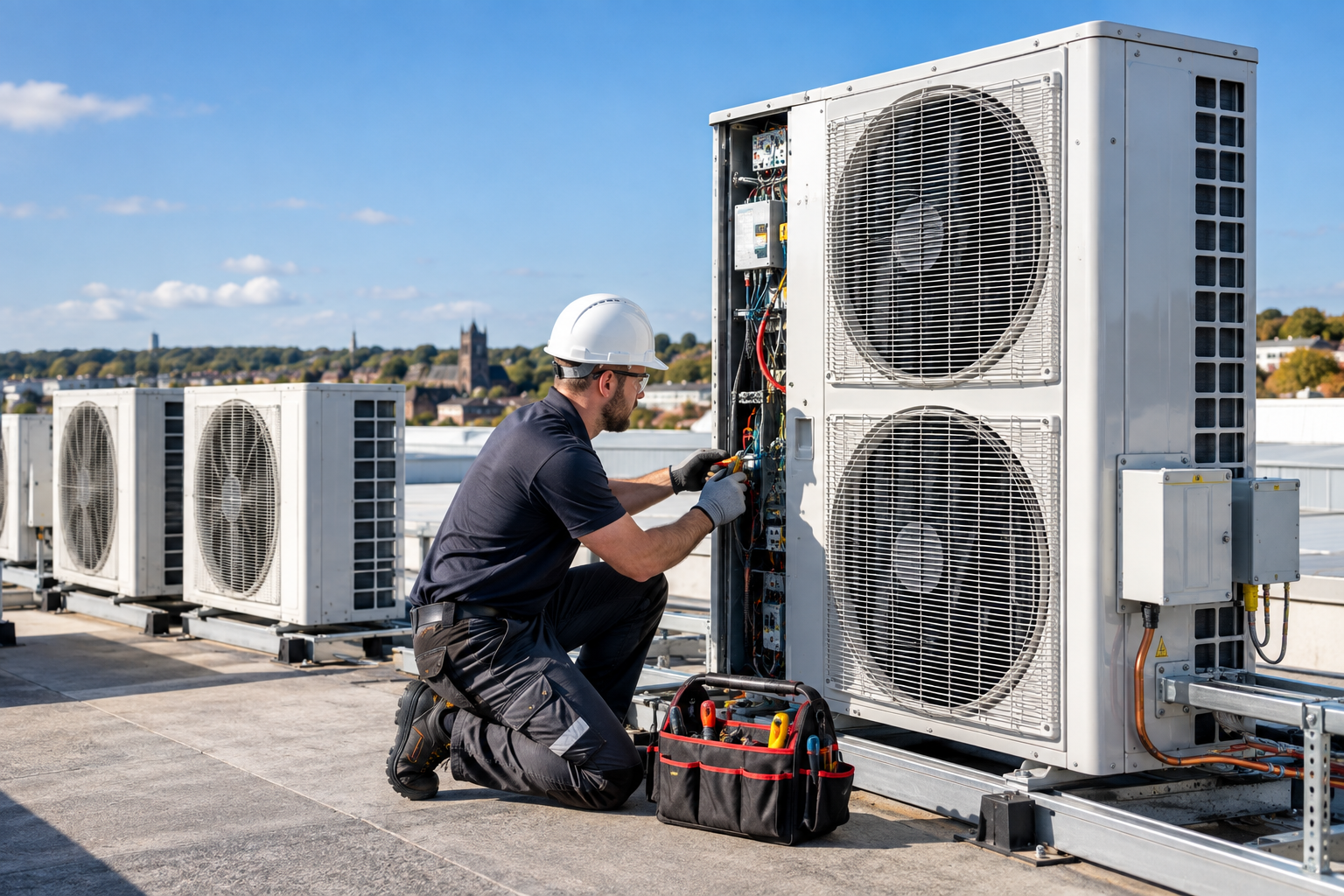
Commercial Air Conditioning in Castleford: Fast, Local and F-Gas Certified
Finding reliable commercial air conditioning Castleford businesses can depend on is about much more than buying a powerful cooling unit. Offices, shops, restaurants, warehouses, healthcare premises and industrial buildings all have different heat loads, occupancy patterns and operating requirements. A correctly designed system needs to provide comfortable temperatures without unnecessarily increasing energy consumption or disrupting day-to-day operations.
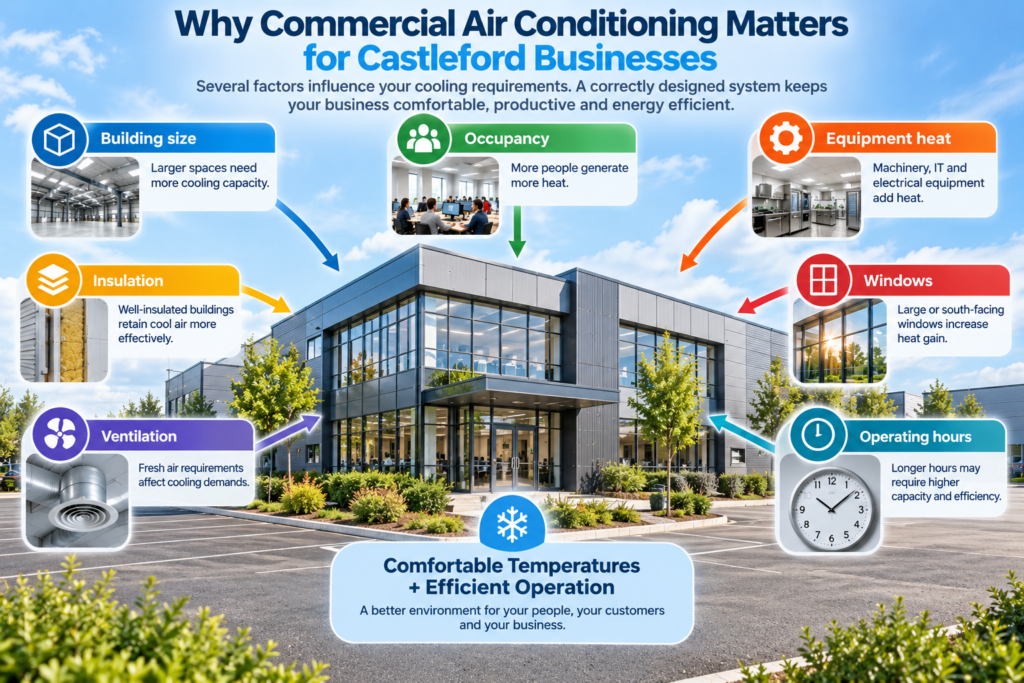
For businesses in Castleford, the right approach starts with understanding the building and how it is used. That means considering room size, insulation, windows, equipment, occupancy, operating hours, ventilation and future expansion before recommending equipment.
Why Commercial Air Conditioning Matters in Castleford
A commercial air conditioning system has to do more than make a room feel cooler. It can help maintain a consistent working environment, support customer comfort and protect temperature-sensitive equipment or products.
The Health and Safety Executive explains that thermal comfort depends on several factors, including air temperature, radiant temperature, air movement, humidity, clothing and workload. There is also no single legal maximum workplace temperature in the UK.
That makes proper system design particularly important. A unit that is too small may run continuously without achieving the desired temperature, while an oversized system can cycle inefficiently and provide less consistent comfort.
Castleford also has a varied commercial environment, ranging from offices and independent retailers to hospitality, industrial and logistics premises. Local competitors commonly promote solutions such as split, cassette, ducted, VRF and VRV systems, alongside servicing and emergency repairs.
Choosing the Right Commercial AC System
Different commercial properties need different configurations. A small office might only require a split system, whereas a larger building with several independently controlled areas could benefit from a VRF or VRV installation.
| System | Typically suited to | Main advantage |
|---|---|---|
| Split | Offices, shops and small commercial rooms | Straightforward individual-zone cooling |
| Multi-split | Several smaller rooms | Multiple indoor units from one outdoor system |
| Ceiling cassette | Open offices, retail and hospitality | Even air distribution with discreet installation |
| Ducted | Larger or architecturally sensitive spaces | Centralised, concealed air distribution |
| VRF/VRV | Multi-zone commercial buildings | Independent temperature control and scalability |
A professional site survey should come before equipment selection. Measurements alone are not enough; the engineer should understand how the premises operate throughout the day.
For example, a restaurant kitchen may generate substantial heat from cooking equipment, while a server or equipment room may have a continuous cooling load even when the building is unoccupied.
Commercial Air Conditioning Services Castleford Businesses Need
A reliable installation is only the beginning. Commercial systems need ongoing attention to remain efficient and dependable.
Professional commercial air conditioning services Castleford businesses use can include system design, installation, commissioning, planned servicing, preventative maintenance, fault diagnosis, repairs and system upgrades.
Maintenance should not simply mean changing a filter and leaving. Engineers should assess system operation, inspect relevant components, identify developing faults and check that performance remains appropriate for the building.
Coldroomplus provides commercial installation, servicing and maintenance alongside VRF/VRV solutions, with its engineers described as F-Gas certified and Level 3 RACHP qualified. The company also offers emergency support and UK-wide coverage.
For a business, preventative maintenance can be particularly valuable because an unexpected AC failure during busy trading hours can create discomfort, lost productivity and operational disruption.

F-Gas Compliance and Air Conditioning Inspections
One of the most important questions to ask an air conditioning contractor is whether the people carrying out refrigerant-related work have the correct qualifications.
The UK Government states that individuals working with F-gas-containing stationary refrigeration, air conditioning and heat pump equipment need appropriate qualifications. Depending on the work, this can include installation, servicing, maintenance, leak checking, refrigerant recovery and decommissioning.
Businesses that service stationary F-gas equipment operated by other organisations also require appropriate company certification. The UK Government specifically includes air conditioning within these requirements.
There is another important compliance consideration for many commercial buildings. In England and Wales, air conditioning systems with an effective rated output above 12kW must generally undergo an energy inspection at intervals of no more than five years. This can include multiple smaller units where their combined effective rated output exceeds 12kW.
The resulting inspection report identifies the system’s efficiency and can recommend improvements. The UK Government also states that failure to obtain the required inspection can result in a £300 fine.
It is therefore worth confirming your property’s obligations rather than assuming that a small individual unit automatically means an inspection is unnecessary.
Why Choose an Experienced Commercial HVAC Engineer?
Commercial cooling problems rarely exist in isolation. Refrigeration, air conditioning, ventilation, heating, electrical requirements and building use can all influence the final solution.
That is why experience matters when a project is more complicated than replacing a domestic wall-mounted unit.
Coldroomplus has more than 25 years of refrigeration and HVAC experience, reports more than 300 happy customers and uses Level 3 RACHP-qualified, F-Gas-certified technicians. Its commercial offering covers installation, servicing, maintenance and VRF/VRV systems.
For businesses, the objective should be straightforward: reliable temperature control, sensible running costs, competent installation and responsive support when something goes wrong.
Key Takeaways
Good commercial air conditioning starts with a proper assessment rather than an off-the-shelf recommendation.
The correct system should reflect occupancy, heat loads, zoning, operating hours and the physical characteristics of the premises.
F-Gas qualifications and company certification are important when refrigerant-related work is being undertaken.
Commercial systems may also have statutory air-conditioning inspection requirements, particularly where combined effective rated output exceeds 12kW.
Finally, planned maintenance can help identify developing problems before they become expensive operational failures.
If your Castleford premises is struggling with uneven temperatures, rising cooling costs or repeated AC breakdowns, what is the biggest problem you’d like a properly designed commercial system to solve?
Frequently Asked Questions
1. What type of air conditioning is best for a commercial building?
There is no universal best system because commercial buildings have different layouts, occupancy patterns and cooling requirements. Split, multi-split, cassette, ducted and VRF/VRV systems can all be appropriate depending on the application.
2. How often should commercial air conditioning be serviced?
The appropriate service frequency depends on equipment, operating conditions, usage and manufacturer recommendations. High-use commercial systems may require more frequent attention than lightly used premises.
3. Does commercial air conditioning need an F-Gas qualified engineer?
Yes, where work falls within activities requiring F-Gas qualifications, the individual carrying it out must have the appropriate qualification. The UK Government specifically covers installation, servicing, maintenance, leak checking, refrigerant recovery and decommissioning.
4. Does every commercial air conditioning system require a TM44 inspection?
Not every system is automatically in scope. In England and Wales, systems with an effective rated output above 12kW generally require an energy inspection at intervals of no more than five years.
5. Can air conditioning reduce workplace discomfort during hot weather?
It can help control indoor temperature, but thermal comfort depends on more than air temperature alone. Health and Safety Executive identifies factors including humidity, air movement, radiant temperature, clothing and workload.
6. Is VRF or VRV suitable for offices?
VRF and VRV can be particularly useful where a building has multiple zones requiring different temperature settings. They can provide centralised control while allowing individual areas to be managed more independently.
7. How can a business reduce commercial AC running costs?
Correct sizing, sensible temperature settings, efficient controls, unobstructed airflow and regular maintenance can all help. Replacing inefficient equipment may also be worthwhile where the existing system is old or unreliable.
8. What should a commercial air conditioning quotation include?
A detailed quotation should explain the proposed system, capacity, indoor and outdoor units, installation requirements, controls, commissioning, warranty and any ongoing maintenance considerations. It should also clearly identify exclusions so there are no surprises later.
9. Can commercial air conditioning provide heating as well as cooling?
Many modern systems can operate as heat pumps, providing both heating and cooling. Whether this is suitable depends on the building, existing heating system, required temperatures and project objectives.
10. What should I do if my commercial AC suddenly stops working?
Check straightforward issues such as the electrical supply and controller settings without attempting refrigerant or electrical repairs yourself. If the fault remains, arrange professional diagnosis promptly, particularly where temperature control is critical to business operations.