Cold Room Installation in Doncaster: Fast, Local and F-Gas Certified
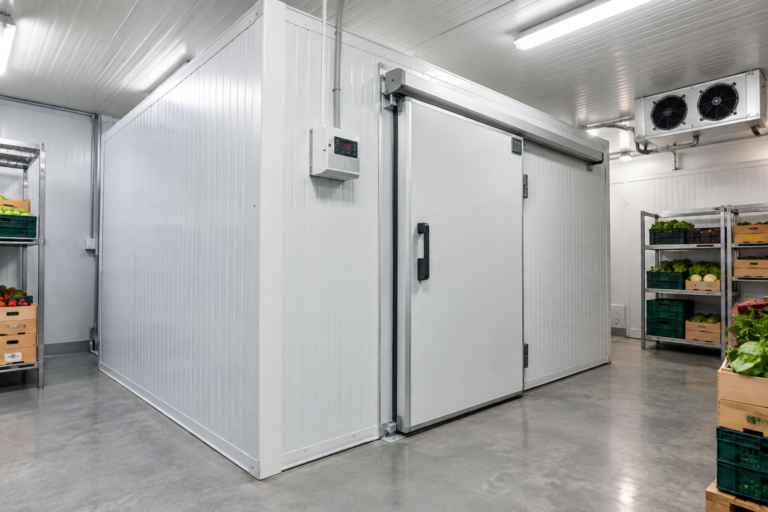
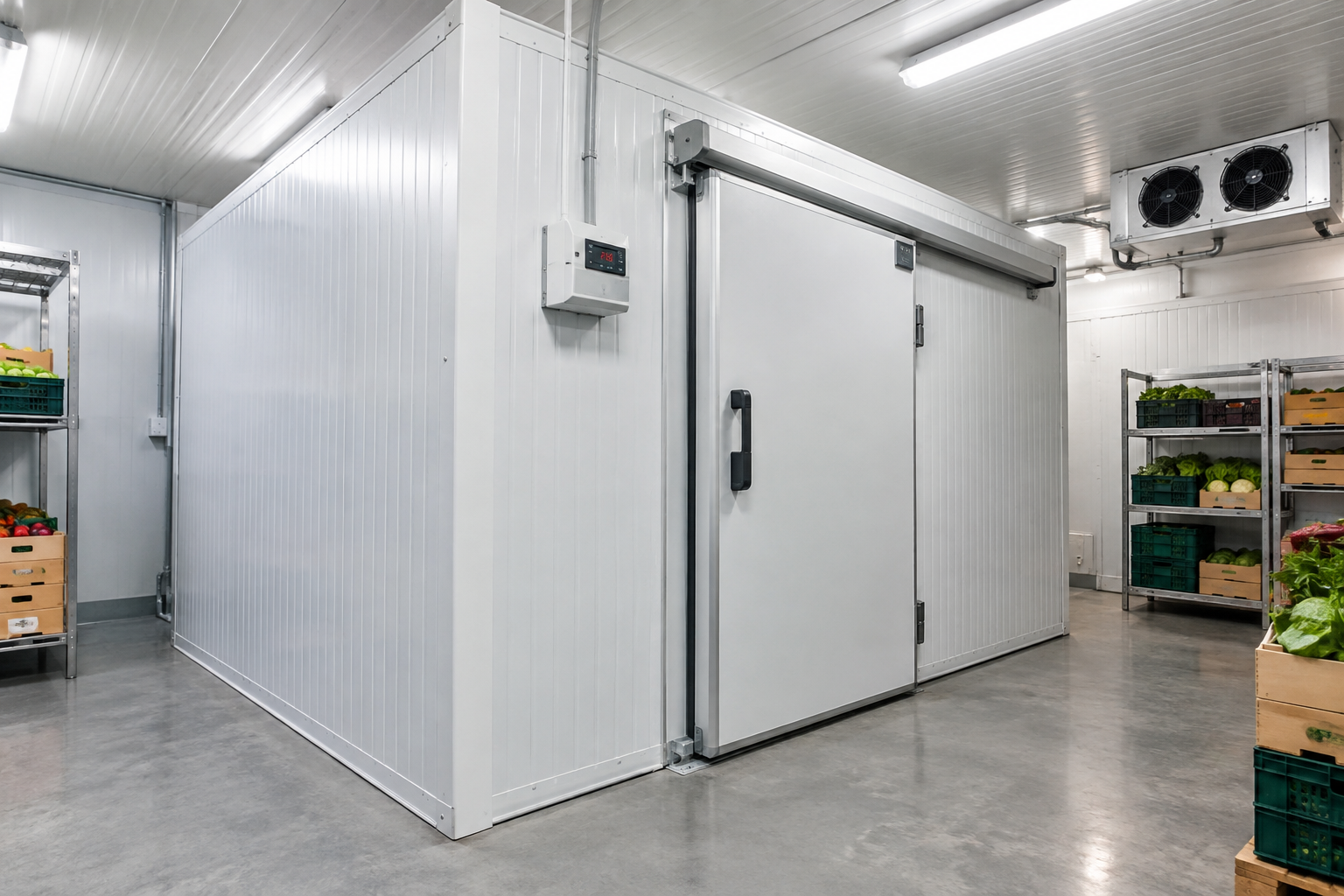
If your business needs dependable cold room installation Doncaster services, choosing the right refrigeration system is about far more than buying an insulated room and fitting a cooling unit. The room, refrigeration capacity, insulation, doors, temperature controls, ventilation and intended use all need to work together.
For restaurants, food manufacturers, caterers, supermarkets, pharmacies, hospitality businesses and other commercial operations, poor cold-room design can lead to temperature instability, unnecessary energy consumption, product losses and avoidable downtime. Professional design and installation therefore matter from the very beginning.
What Is Involved in Cold Room Installation?
A commercial cold room is a controlled-temperature environment designed around a particular storage requirement. A chilled food room, for example, has very different requirements from a freezer room operating at substantially lower temperatures.
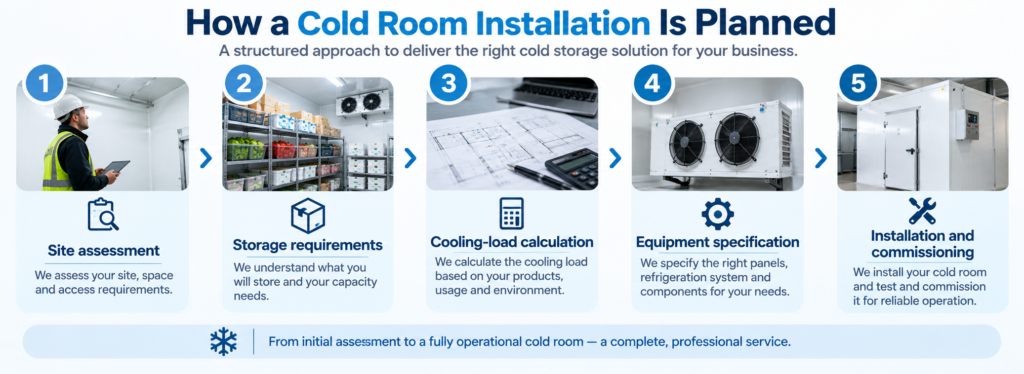
A professional installation normally begins with a site assessment. The engineer needs to consider the available space, room dimensions, insulation requirements, door position, product type, expected stock volume, frequency of door opening, ambient conditions and the desired operating temperature.
The refrigeration system must then be selected to provide sufficient cooling capacity without being unnecessarily oversized. Oversizing can increase purchase and operating costs, while an undersized system may struggle to maintain temperature when the room is heavily loaded or frequently accessed.
This is why the best cold room installation Doncaster projects start with the application rather than a standard package.
Chiller or Freezer: Which Do You Need?
The answer depends on what you are storing.
| Requirement | Typical application | Main consideration |
|---|---|---|
| Chilled storage | Fresh food, ingredients and prepared products | Stable chilled temperature |
| Frozen storage | Frozen food and long-term frozen stock | Lower temperatures and stronger insulation |
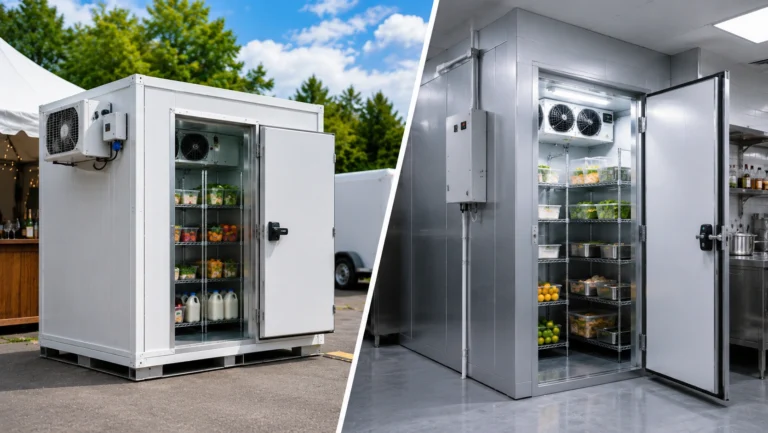
| Bespoke cold storage | Manufacturing, catering and specialist applications | Designed around the process |
The precise temperature should always be determined by the product, manufacturer instructions and applicable food-safety requirements rather than simply choosing a temperature because it is commonly used.
The Food Standards Agency recommends that fridges used for chilled food should generally operate at 5°C or below, while food businesses in England, Wales and Northern Ireland have a legal requirement to keep relevant chilled food below 8°C, subject to specified exceptions.
What Should You Look For in a Cold Room Installation in Doncaster?
A good cold room should provide more than low temperatures. It should maintain those temperatures consistently under the conditions in which your business actually operates.
Insulated panels are particularly important because inadequate insulation allows heat into the room and makes the refrigeration system work harder. Door construction is equally important. Every opening introduces warmer air, so a busy food operation may require a different door arrangement and refrigeration specification from a low-traffic storage facility.
The location of the condensing unit also matters. Poor airflow around the equipment can affect performance, while unsuitable positioning can make future servicing more difficult.
Controls and temperature monitoring deserve attention too. A system that gives staff clear temperature information and warning of abnormal conditions can help businesses react before stock is compromised.
The FSA‘s research into chilled-food storage found that inconsistent temperature-checking routines were an issue among some food businesses. In its observed sample, eight of 29 businesses with fridge temperature data had average temperatures above the recommended 5°C maximum, while one had an average above the legal 8°C limit.
Common Cold Room Installation Mistakes
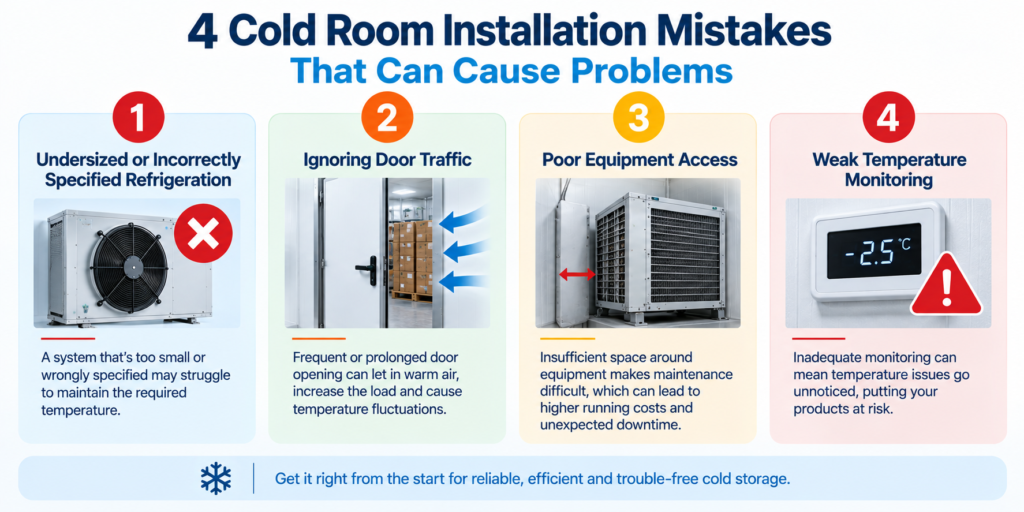
One common mistake is choosing refrigeration capacity based solely on room size. Cooling load is influenced by more than cubic metres. Product temperature, product quantity, ambient temperature, door openings, lighting and heat entering through the structure can all affect the required capacity.
Another mistake is overlooking the way employees actually use the room. A cold room beside a busy preparation area with constant door traffic needs to be designed accordingly.
Poor equipment positioning is another avoidable problem. If engineers cannot easily access the refrigeration equipment, future maintenance can become slower and more disruptive.
Businesses can also make the mistake of treating temperature monitoring as an afterthought. A reliable monitoring process is particularly important where temperature-sensitive products are involved.
What to Expect From Professional Cold Room Engineers Doncaster
A competent installation should involve more than assembling panels and switching on a refrigeration unit.
The process should begin with understanding the business requirement and surveying the proposed location. The specification should then account for the room’s dimensions, temperature requirement, expected usage and refrigeration load.
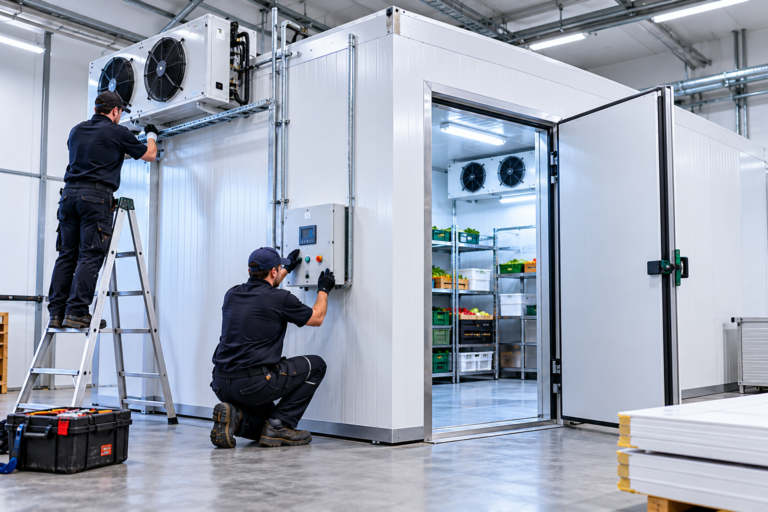
During installation, panels, doors, refrigeration equipment, controls and associated services need to be installed correctly. The completed system should then be checked and commissioned so the operator understands how it should perform.
For a business selecting cold room engineers in Doncaster, ask about relevant qualifications, F-Gas certification, commissioning procedures, warranty arrangements, spare parts and emergency support.
Coldroomplus provides bespoke cold-room solutions with F-Gas-certified, Level 3 RACHP-qualified technicians, 25+ years of experience, a stated one-year extended warranty and genuine spare parts, with a free site survey available within a 50-mile radius.
Cold Room Maintenance and Emergency Support
Installation is only the beginning of a cold room’s working life.
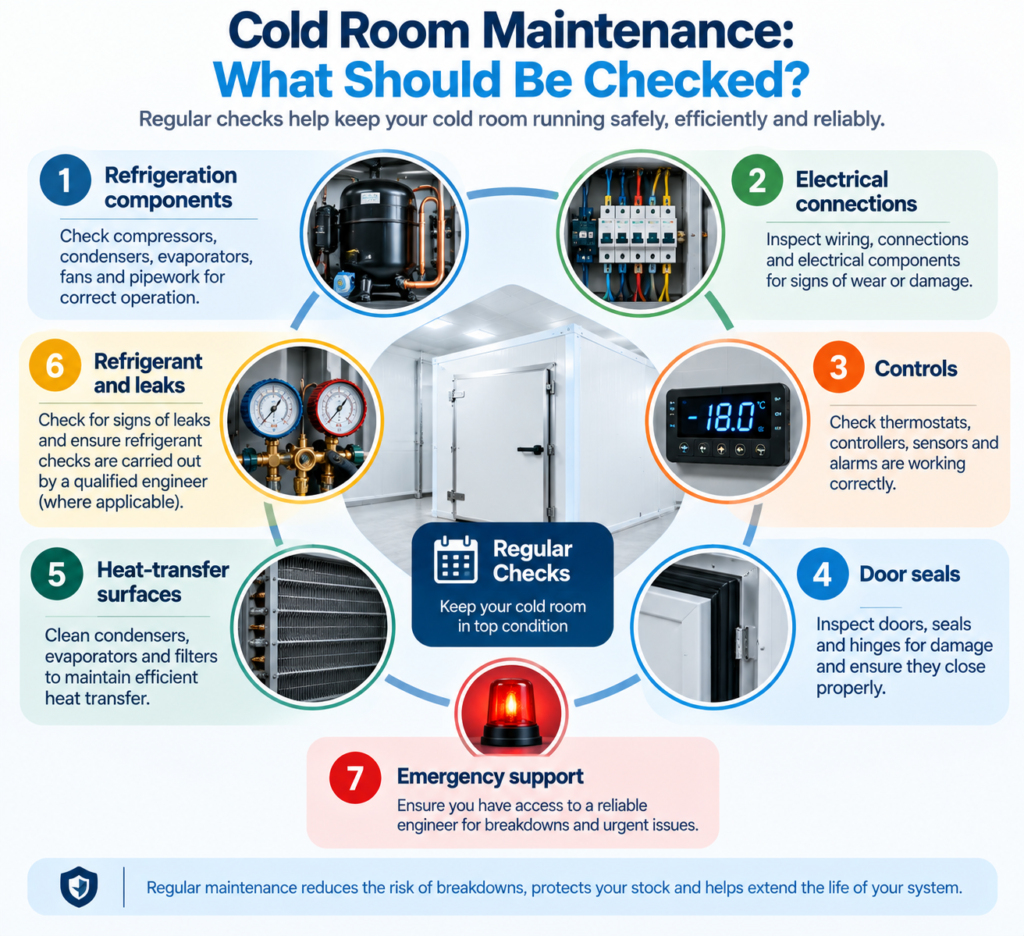
Routine maintenance can help identify developing problems before they become major failures. Engineers can inspect refrigeration components, electrical connections, controls, door seals, heat-transfer surfaces and other system components according to the equipment and maintenance requirements.
F-gas responsibilities may also apply to qualifying equipment. The UK Government explains that certain equipment must be checked for refrigerant leaks and that operators may have record-keeping responsibilities depending on the quantity and type of F-gas involved.
Pressure-system safety should also be considered where applicable. The Health and Safety Executive‘s guidance explains that the Pressure Systems Safety Regulations 2000 address risks associated with stored energy in pressure systems and apply responsibilities to relevant users, owners, designers, manufacturers and installers.
For businesses relying on continuous refrigeration, having access to emergency repairs and ongoing technical support can therefore be just as important as selecting the initial installer.
Key Takeaways Before You Order a Cold Room
The right cold room starts with the products and processes you need to protect. Size, temperature, insulation, refrigeration capacity, door usage and equipment location should all be assessed together.
Your installer should also have the appropriate refrigeration qualifications and F-Gas credentials where required. Don’t judge quotations on price alone; compare the technical specification, commissioning, warranty, maintenance and support included.
Finally, think about the system’s future as well as its immediate performance. Refrigerant regulations are evolving, making sensible equipment selection increasingly important for long-term operation.
If you’re planning cold room installation Doncaster businesses can rely on, a professional site survey is a sensible first step because it allows the refrigeration requirement to be assessed before equipment is specified.
If your business is planning a new cold room or replacing an unreliable refrigeration system, what would you need your ideal installation to achieve—more storage, lower running costs, better temperature control or greater peace of mind?
Frequently Asked Questions
1. How much does cold room installation cost in Doncaster?
There is no universal installation price because commercial cold rooms vary considerably in size, temperature requirement, insulation, refrigeration capacity and site complexity. A proper quotation should be based on the specific application and site rather than a generic price per square metre.
2. How long does it take to install a commercial cold room?
Installation time depends on the room size, specification, access, refrigeration system and any electrical or building work required. A straightforward modular installation can be considerably quicker than a large bespoke project with complex site requirements.
3. What temperature should a commercial cold room be?
There is no single temperature suitable for every product. Businesses should follow product-specific storage instructions and applicable food-safety requirements; the Food Standards Agency generally recommends refrigerators operate at 5°C or below, while relevant chilled food must generally be kept below 8°C under UK food-safety rules.
4. Do cold room engineers need F-Gas certification?
Yes, appropriate qualifications are required for regulated activities involving F-gases in relevant stationary refrigeration equipment. The UK Government states that qualified personnel are required for activities including installation, servicing, maintenance, leak checking and refrigerant recovery.
5. What is the difference between a chiller and freezer cold room?
A chiller is designed for products requiring chilled rather than frozen storage, whereas a freezer operates at substantially lower temperatures. The difference affects insulation, refrigeration capacity, doors, controls and overall installation requirements.
6. Can a cold room be built to a custom size?
Yes. Commercial cold rooms can be designed around available space, storage requirements and operational needs. Bespoke construction can be particularly useful where standard modular dimensions do not suit the building or workflow.
7. How can I reduce cold room running costs?
Start with good insulation, correctly sized refrigeration equipment and well-sealed doors. Regular maintenance, unobstructed condenser airflow and sensible door-opening practices can also help the system maintain temperature efficiently.
8. How often should a commercial cold room be serviced?
The appropriate service interval depends on the equipment, operating environment, manufacturer recommendations and regulatory requirements. High-use refrigeration systems may justify a proactive maintenance programme because identifying problems early can reduce unexpected downtime.
9. What should I ask a cold room installer before hiring them?
Ask about refrigeration qualifications, F-Gas certification where applicable, system design, commissioning, warranty coverage, spare-parts availability, maintenance arrangements and emergency support. It is also sensible to ask exactly what the quotation includes so different installers can be compared fairly.
10. Do F-Gas rules affect new cold room installations?
They can. UK rules restrict certain high-GWP F-gases in new equipment and the government continues to phase down HFC availability, so refrigerant selection should be considered carefully when designing a new system.