Modular vs Bespoke Walk-In Freezer: Which Is Right for You?
Choosing the right walk-in freezer is no longer just about storage space. Businesses across the UK are now looking closely at energy efficiency, installation speed, long-term flexibility, and operational performance before investing in commercial refrigeration.
One of the most common decisions businesses face is whether to choose a modular freezer system or invest in a fully bespoke solution.
At first glance, both options appear similar because they perform the same basic function — maintaining stable frozen storage temperatures. However, the way they are built, installed, and customised can create major differences in cost, efficiency, scalability, and long-term practicality.
For businesses researching modular vs bespoke walk-in freezer systems, understanding these differences is critical before making a long-term investment.
Restaurants, supermarkets, pharmaceutical facilities, florists, catering businesses, warehouses, and even luxury residential properties now depend heavily on reliable frozen storage systems to protect stock quality and improve operational efficiency.
According to the British Frozen Food Federation, frozen food demand in the UK continues to grow steadily due to changing buying habits, bulk storage preferences, and reduced food waste. This has increased demand for both modular and bespoke refrigeration systems across multiple industries.
What Is a Modular Walk-In Freezer?
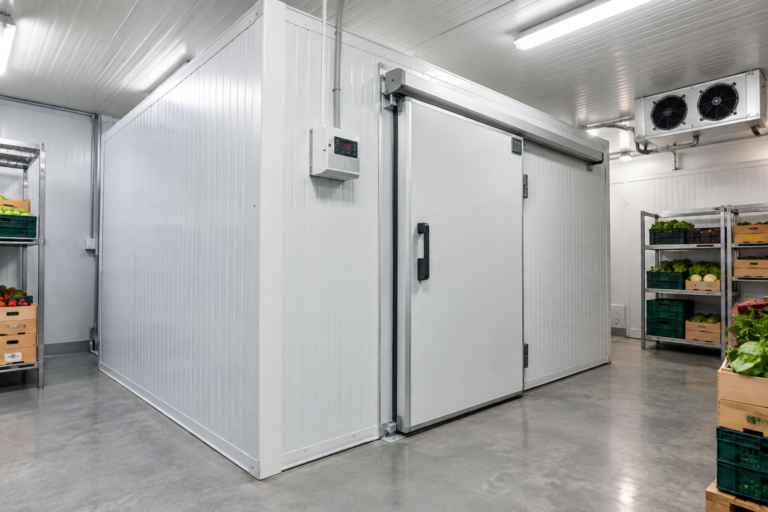
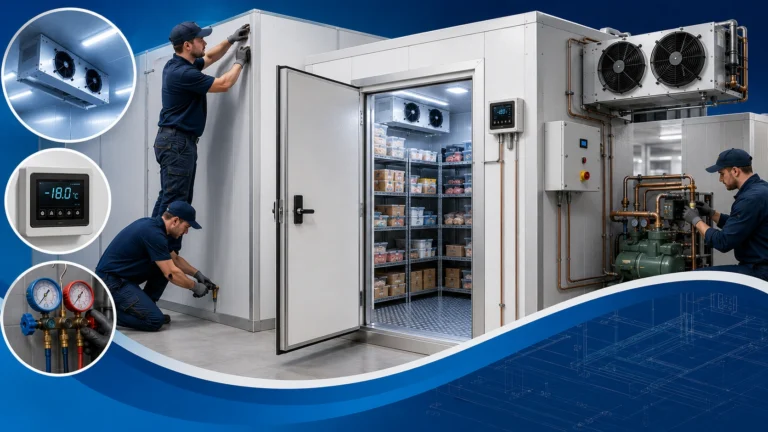
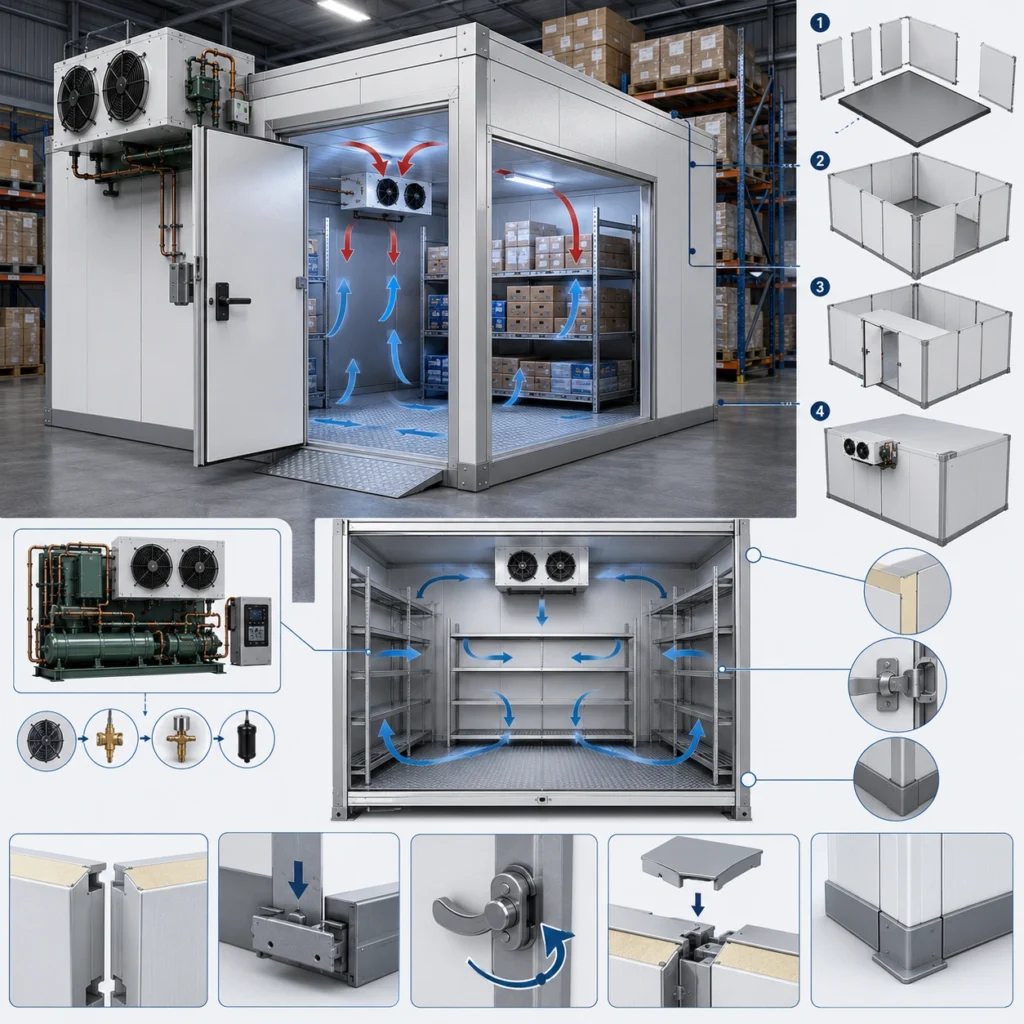
A modular walk-in freezer is a prefabricated refrigeration system made using standardised insulated panels and pre-designed refrigeration components.
These systems are manufactured in sections and assembled on-site.
Because modular systems use standardised dimensions and components, installation is usually faster and more cost-effective than fully custom refrigeration rooms.
Modular freezer systems are particularly popular with businesses needing:
- Faster installation
- Predictable costs
- Expandable refrigeration
- Standard storage applications
- Flexible relocation options
Restaurants, convenience stores, cafés, florists, and smaller food businesses often choose modular systems because they provide reliable frozen storage without requiring highly customised layouts.
Another major advantage is scalability.
Many modular systems can later be expanded or reconfigured if storage requirements increase over time.
What Is a Bespoke Walk-In Freezer?
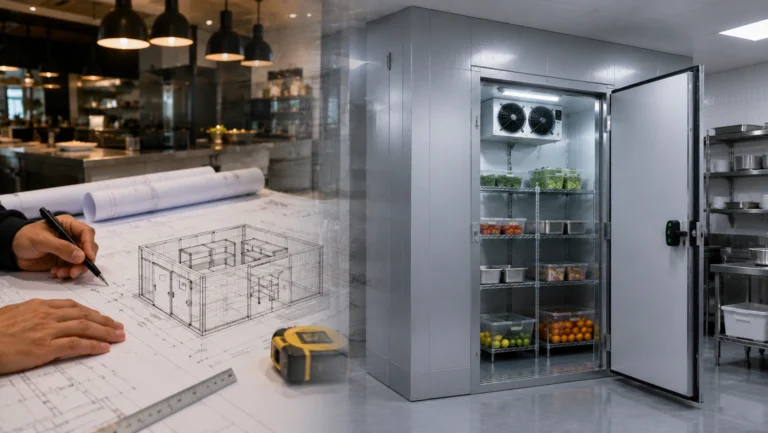
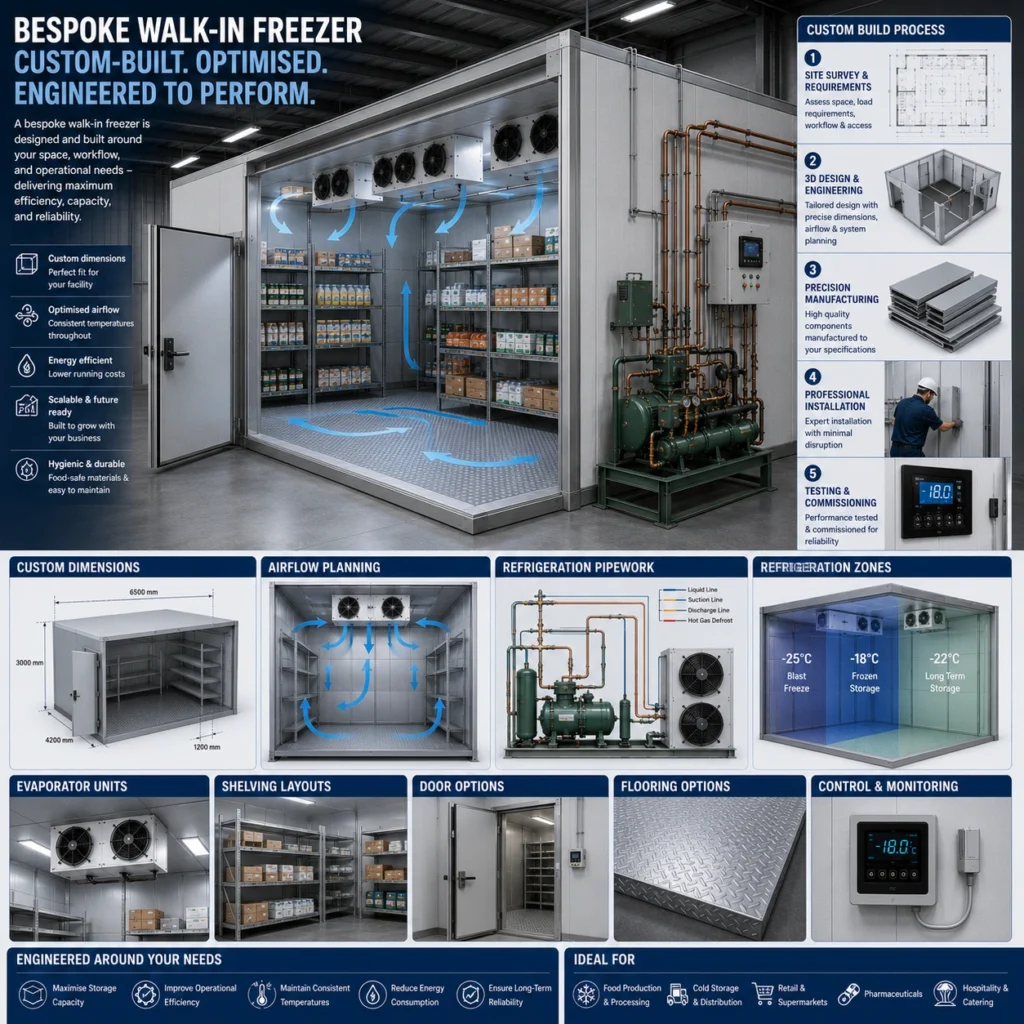
A bespoke walk-in freezer is fully custom-built around the exact needs of the property and business operation.
Unlike modular systems, bespoke freezers are designed specifically for the available space, operational workflow, storage requirements, and refrigeration demands of the customer.
This allows far greater flexibility for unusual layouts or specialised commercial applications.
Bespoke systems are commonly used in:
- Large supermarkets
- Pharmaceutical facilities
- Food production plants
- Industrial cold storage
- Luxury hospitality projects
- Complex commercial buildings
Because bespoke systems are tailored individually, they often involve more detailed planning, refrigeration engineering, airflow calculations, and installation coordination.
Although installation usually takes longer and costs more upfront, bespoke refrigeration systems can maximise available space and optimise operational efficiency far more effectively in certain environments.
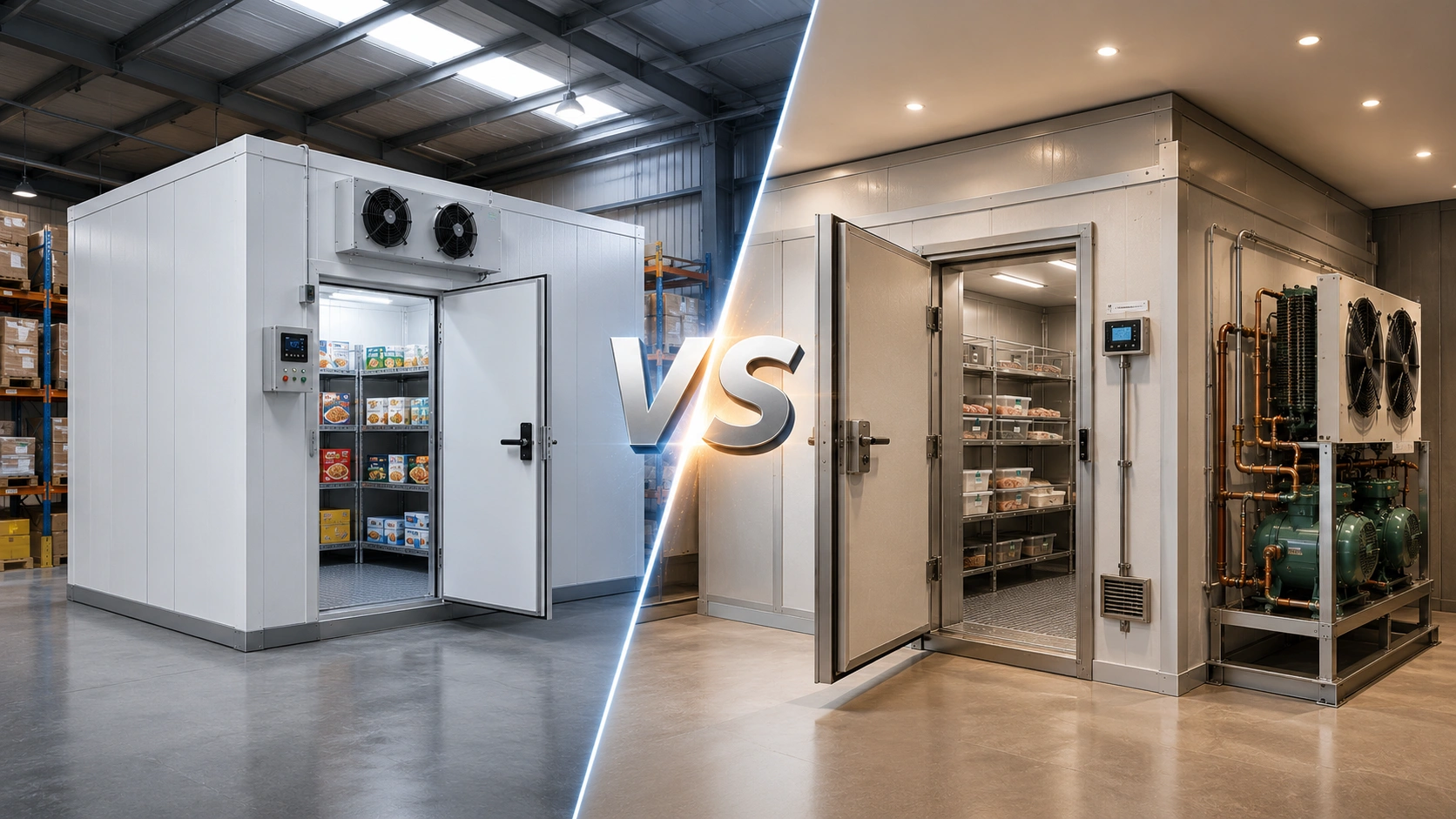
The Biggest Difference Between Modular vs Bespoke Walk-In Freezer Systems
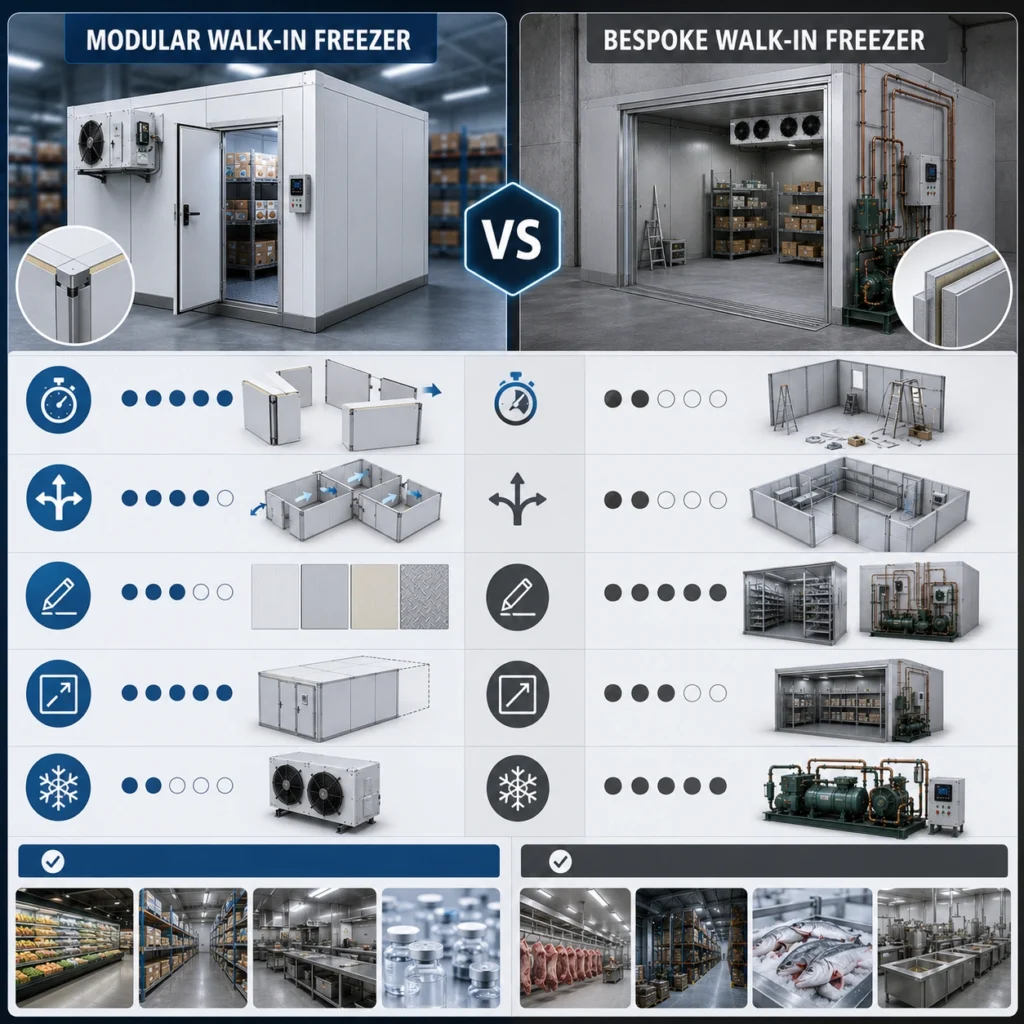
The primary difference comes down to flexibility versus simplicity.
Modular systems prioritise faster installation and standardisation.
Bespoke systems prioritise complete customisation and maximum operational optimisation.
Feature | Modular Walk-In Freezer | Bespoke Walk-In Freezer |
Installation Speed | Faster | Longer |
Cost Predictability | Higher | Variable |
Customisation | Limited | Extensive |
Space Efficiency | Standard layouts | Fully optimised layouts |
Scalability | Often expandable | Fully tailored |
Best For | Small-to-medium businesses | Large or specialised operations |
For many businesses, the decision depends on whether standard refrigeration layouts are sufficient or whether the operation requires highly specialised cold storage functionality.
Want a tailored recommendation or quick quote? Reach out today
Which Option Is More Energy Efficient?
Energy efficiency depends less on whether the system is modular or bespoke and more on how well the freezer is engineered and installed.
According to the Carbon Trust, refrigeration systems can account for up to 50% of electricity usage in food businesses. This makes refrigeration efficiency one of the most important operational considerations for long-term cost control.
A poorly installed freezer — modular or bespoke — can suffer from:
- Air leaks
- Compressor strain
- Temperature instability
- Excessive ice build-up
- High energy consumption
However, bespoke systems sometimes achieve higher efficiency in larger commercial environments because they are engineered specifically around operational workflows and building conditions.
Modular systems, meanwhile, often perform extremely efficiently for smaller businesses because standardised manufacturing allows consistent insulation quality and simpler refrigeration layouts.
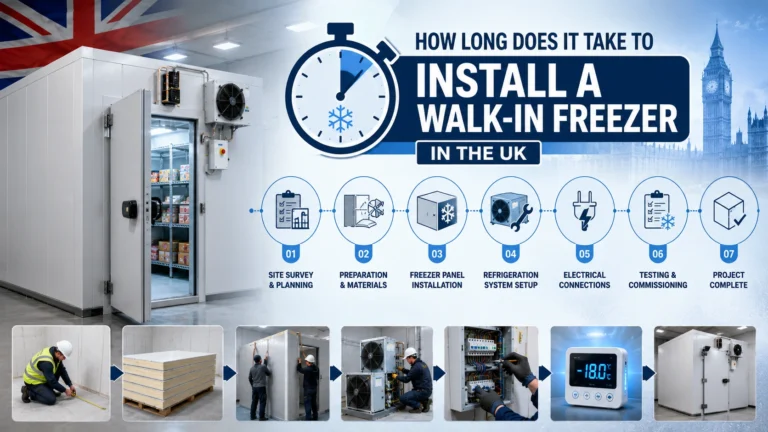
Installation Time Differences
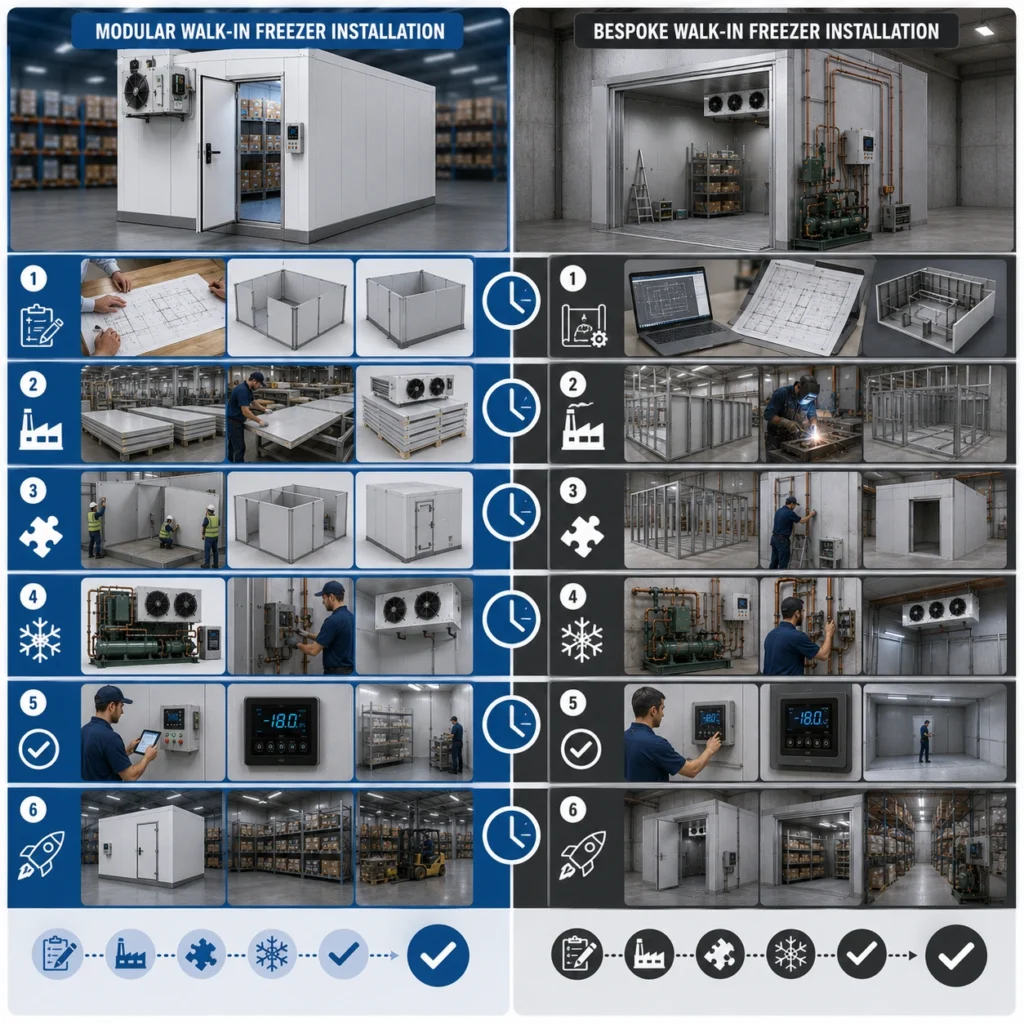
One major advantage of modular walk-in freezer installation is speed.
Because components are prefabricated, installation can often be completed relatively quickly once the site is prepared.
Many modular systems can be operational within one to several days depending on size and complexity.
Bespoke systems usually take longer because engineers must design, manufacture, and coordinate custom refrigeration layouts specifically for the property.
This often involves:
- Detailed site surveys
- Heat load calculations
- Custom panel fabrication
- Refrigeration engineering
- Complex airflow planning
- Multi-stage commissioning
For businesses needing rapid deployment, modular systems often provide a practical advantage.
Why Businesses Often Choose Bespoke Systems
Although bespoke systems cost more upfront, they are often preferred in industries where refrigeration performance directly affects operational efficiency.
For example:
A pharmaceutical facility may require extremely precise temperature zoning and monitoring.
A food production facility may need freezer layouts integrated into production workflows.
A large supermarket may require maximum storage capacity within restricted building dimensions.
In these situations, bespoke refrigeration systems often deliver better long-term operational performance despite higher initial investment.
The International Institute of Refrigeration also notes that refrigeration systems play a major role in global food preservation and supply chain efficiency, making refrigeration optimisation increasingly important across multiple industries.
Are Modular Systems Better for Smaller Businesses?
In many cases, yes.
Restaurants, cafés, florists, convenience stores, and smaller food businesses often benefit from modular systems because they offer:
- Faster installation
- Lower upfront costs
- Simplified expansion
- Predictable layouts
- Reliable refrigeration performance
Many businesses searching online for modular walk-in freezer installation are looking for practical refrigeration solutions that can be operational quickly without extensive construction work.
For growing businesses, modular systems can also provide greater flexibility if future relocation or expansion becomes necessary.
Domestic Walk-In Freezer Demand Is Growing Too
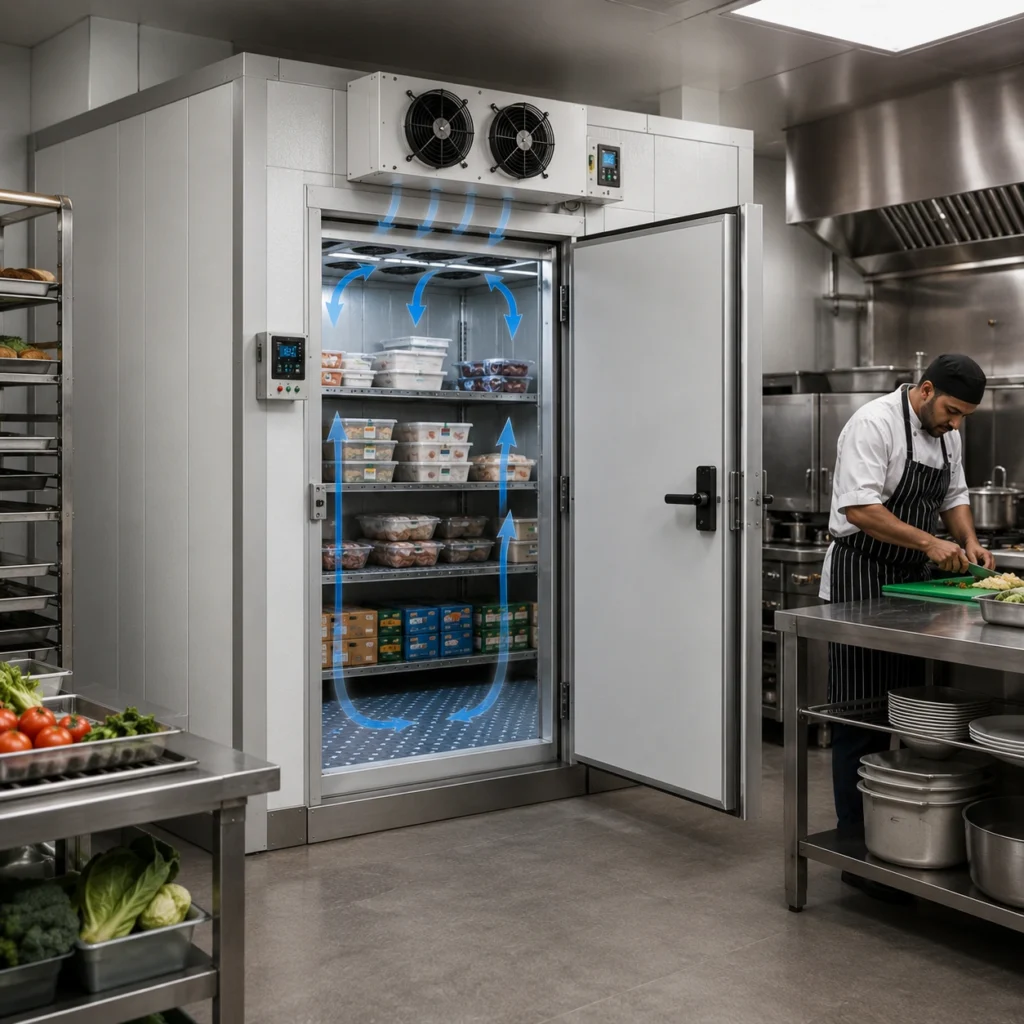
Although most walk-in freezer projects remain commercial, residential demand is growing steadily across the UK.
Luxury homes, country estates, and large domestic kitchens increasingly install freezer rooms for:
- Bulk food storage
- Meal preparation
- Home entertaining
- Outdoor kitchen refrigeration
- Long-term frozen storage
For domestic customers, modular systems are often more practical because installation is quicker and layouts are usually simpler than large commercial refrigeration environments.
However, bespoke systems may still appeal to homeowners wanting highly customised refrigeration spaces integrated into luxury residential properties.
Want a tailored recommendation or quick quote? Reach out today
What Businesses Across Leeds Are Prioritising Today
Businesses throughout Leeds are increasingly focusing on refrigeration systems that balance installation speed, energy efficiency, operational flexibility, and long-term scalability.
Restaurants, food manufacturers, florists, pharmaceutical facilities, and supermarkets are all under growing pressure to improve refrigeration efficiency while maintaining reliable frozen storage performance.
As electricity costs remain elevated across the UK, businesses are paying far closer attention to:
- Refrigeration efficiency
- Installation quality
- Expansion flexibility
- Operational workflow
- Energy consumption
- Long-term maintenance planning
For companies comparing modular vs bespoke walk-in freezer systems, the right solution usually depends on operational complexity, available space, and future business growth plans rather than simply choosing the lowest upfront cost.
FAQs – Modular vs Bespoke Walk-In Freezer
1. What is the difference between a modular and bespoke walk-in freezer?
A modular walk-in freezer uses prefabricated standard sections that are assembled on site, while a bespoke walk-in freezer is custom-built to match the exact size, layout, and operational needs of the property. Modular systems are usually faster to install, while bespoke systems offer more flexibility.
2. Which is better: modular or bespoke walk-in freezer?
The best option depends on your space, budget, and how the freezer will be used. Modular systems are often better for businesses needing a quicker, more cost-effective solution. Bespoke systems are usually better for larger or more complex sites that need a fully tailored refrigeration layout.
3. Is modular walk-in freezer installation faster than bespoke installation?
Yes. Modular walk-in freezer installation is generally faster because the panels and components are prefabricated. Bespoke installations usually take longer because the system is designed and built specifically for the site.
4. Are bespoke walk-in freezers more expensive?
In most cases, yes. Bespoke walk-in freezer installation usually costs more upfront because it involves custom design, tailored fabrication, and more detailed engineering work. However, it can offer better space use and performance for specialised sites.
5. Which walk-in freezer is better for small businesses?
Modular walk-in freezers are often the better choice for small businesses because they are easier to install, more predictable in cost, and suitable for standard storage needs.
6. Can a modular walk-in freezer be expanded later?
Yes. Many modular systems can be expanded or reconfigured later if your storage needs grow. This makes them a practical option for businesses planning future growth.
7. Are bespoke walk-in freezers more energy efficient?
They can be, especially in larger or more complex buildings, because they are designed around the exact site layout and workflow. However, overall efficiency depends on installation quality, insulation, refrigeration design, and maintenance.
8. Do domestic customers need modular or bespoke walk-in freezers?
Domestic customers often choose modular systems because they are simpler and quicker to install. Bespoke systems may be better for large luxury homes or properties with special layout requirements.
9. How long does walk-in freezer installation take?
Installation time depends on the system type and site conditions. Modular walk-in freezer installation is usually quicker, while bespoke systems often take longer due to custom fabrication and more detailed engineering work.
10. What businesses commonly use walk-in freezers?
Walk-in freezers are widely used by restaurants, supermarkets, food production facilities, florists, catering companies, warehouses, pharmaceutical businesses, and some domestic properties.
11. How do I choose the right walk-in freezer for my business?
Start by considering your storage requirements, available space, installation timeline, future growth plans, and budget. If you need a standard solution quickly, modular is often best. If you need a highly tailored setup, bespoke may be the stronger option.