How to Spec a Walk-In Freezer for a New Build Restaurant
Starting a new restaurant is exciting, but one costly mistake can create years of operational headaches: undersizing or incorrectly specifying your cold storage. A properly planned walk in freezer installation is not simply about choosing a box that keeps food frozen. It directly affects food safety, energy consumption, kitchen workflow, labour efficiency, and long-term operating costs.
According to the U.S. Department of Energy, walk-in coolers and freezers are among the most energy-intensive pieces of equipment in foodservice facilities, which is why careful specification during the planning stage is essential.
If you are building a new restaurant, here’s exactly how to specify a walk-in freezer that will support your operation today and remain efficient as your business grows.
Why Proper Walk-In Freezer Specification Matters
Many restaurant owners underestimate future storage requirements and only consider their opening-day needs.
Unfortunately, restaurants rarely operate at their initial capacity forever. Seasonal fluctuations, menu expansion, catering services, and increased customer demand can quickly overwhelm an undersized freezer.
An incorrectly specified restaurant walk in freezer installation can lead to:
- Food waste due to insufficient storage
- Staff congestion and inefficient workflows
- Increased energy bills
- Frequent maintenance issues
- Regulatory compliance problems
- Expensive retrofits later
Industry experts recommend prioritising functionality, accessibility, and future scalability rather than focusing solely on upfront costs.
Step 1: Calculate Your Restaurant's Storage Requirements
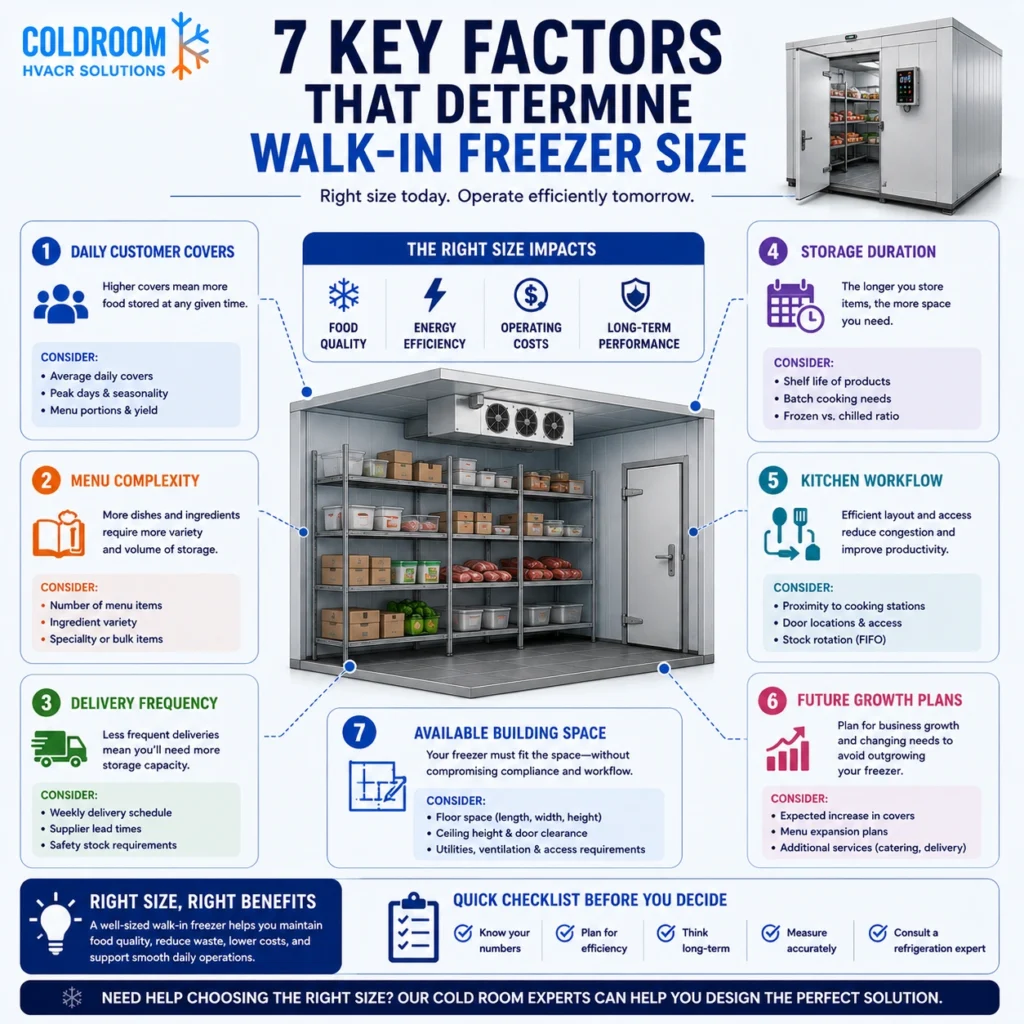
The first step of any walk in freezer installation is determining how much frozen inventory your restaurant will actually hold.
Do not estimate based on floor space alone.
Instead, evaluate:
Daily Customer Volume
Ask yourself:
- How many covers will you serve daily?
- Will weekends significantly increase demand?
- Do you plan to offer catering?
Menu Complexity
Restaurants with seafood, meat-heavy menus, or extensive dessert offerings typically require more freezer storage than cafes or quick-service establishments.
Delivery Schedule
Restaurants receiving deliveries twice weekly need substantially more storage than businesses receiving daily deliveries.
A good rule is to account for 25-30% extra capacity beyond your initial projections to accommodate growth.
Restaurant Walk-In Freezer Size Calculator
Calculate the precise cubic capacity, modular room dimensions, and energy profiles required to support your restaurant's kitchen stock levels.
Engineered Walk-In Freezer Specifications
Cold Room Plus Kitchen Layout Assessment:
Step 2: Choose the Right Freezer Dimensions
Avoid selecting dimensions purely based on available room.
Instead, design around operational flow.
Consider:
Staff Traffic Patterns
The freezer should be located close to food preparation areas but away from cooking equipment that generates excessive heat.
Commercial kitchen experts recommend positioning cold storage near receiving zones to reduce unnecessary movement across the kitchen.
Allow Adequate Clearance
Leave enough room for:
- Door swings
- Shelving systems
- Pallet access
- Staff movement
- Cleaning access
Typical Restaurant Freezer Sizes
Restaurant Type | Suggested Freezer Size | Approximate Capacity |
Small Café | 6′ x 8′ | 250-350 cubic feet |
Casual Dining | 8′ x 10′ | 500-700 cubic feet |
Full-Service Restaurant | 10′ x 12′ | 900-1,200 cubic feet |
High Volume Restaurant | 12′ x 16′ | 1,500+ cubic feet |
These figures vary depending on menu requirements.
Maintaining these temperatures consistently helps preserve flavour, texture, and food safety compliance.
Step 3: Specify Proper Insulation
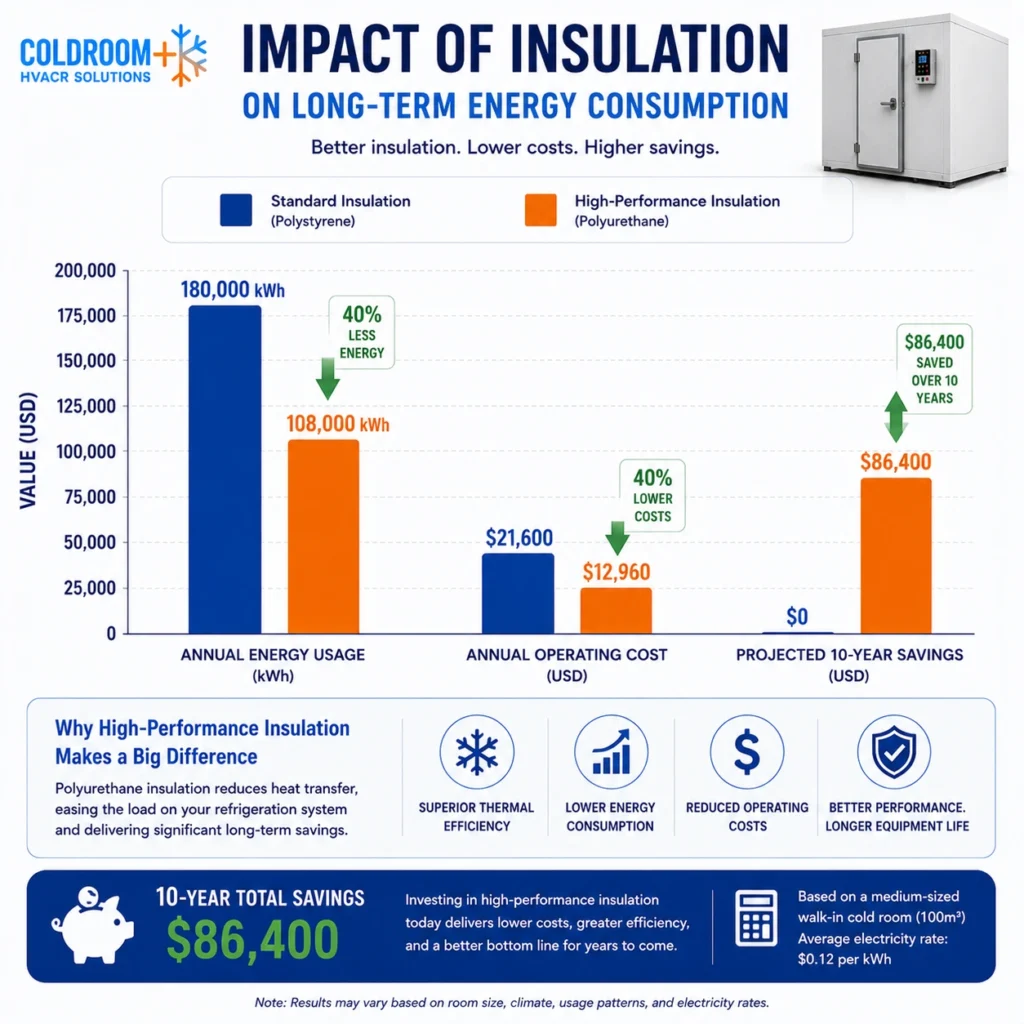
Insulation is one of the most important elements of a successful walk in freezer installation.
Higher insulation performance directly impacts operating costs.
Many commercial freezers use polyurethane insulation because of its superior thermal performance. Industry guidance consistently recommends high-performance insulated panels to reduce energy loss.
Pay attention to:
Panel Thickness
Most commercial walk-in freezers use:
- 4 to 5-inch insulated panels
- Vapour-tight construction
- Thermal break technology
Floor Insulation
Floor insulation is often overlooked.
For new builds, properly insulated floors help minimise heat transfer and improve energy efficiency.
Step 4: Plan Temperature Requirements Correctly
Not every restaurant needs the same temperature settings.
Most commercial freezers operate between 0°F and -10°F (-18°C to -23°C).
Certain products require specialised temperatures.
Examples include:
Food Category | Recommended Temperature |
General Frozen Foods | -18°C |
Seafood | -20°C |
Ice Cream | -23°C or lower |
Prepared Meals | -18°C |
Avoid setting temperatures colder than necessary because every extra degree significantly increases energy usage.
Step 5: Prioritise Energy Efficiency
Energy efficiency should be specified from the beginning rather than added later.
The Department of Energy regularly updates energy conservation standards because walk-in freezers consume substantial electricity throughout their lifespan.
Specify features such as:
LED Lighting
LED lighting generates less heat and consumes less energy.
Automatic Door Closers
These reduce cold air loss.
Heated Door Frames
These prevent ice build-up.
Digital Monitoring Systems
These optimise performance and alert operators to issues early.
Strip Curtains
These reduce temperature fluctuations when staff enter frequently.
Want a tailored recommendation or quick quote? Reach out today
Step 6: Ensure Food Safety and Regulatory Compliance
Compliance should never be an afterthought.
Commercial refrigeration equipment should meet recognised food safety standards.
The NSF establishes sanitation and food protection requirements for commercial refrigerators and freezers, including walk-in systems.
Look for compliance with:
- NSF/ANSI 7
- NSF/ANSI 2
- NSF/ANSI 51
- NSF/ANSI 52
These standards address:
- Cleanable surfaces
- Food-safe materials
- Proper flooring systems
- Protection against contamination
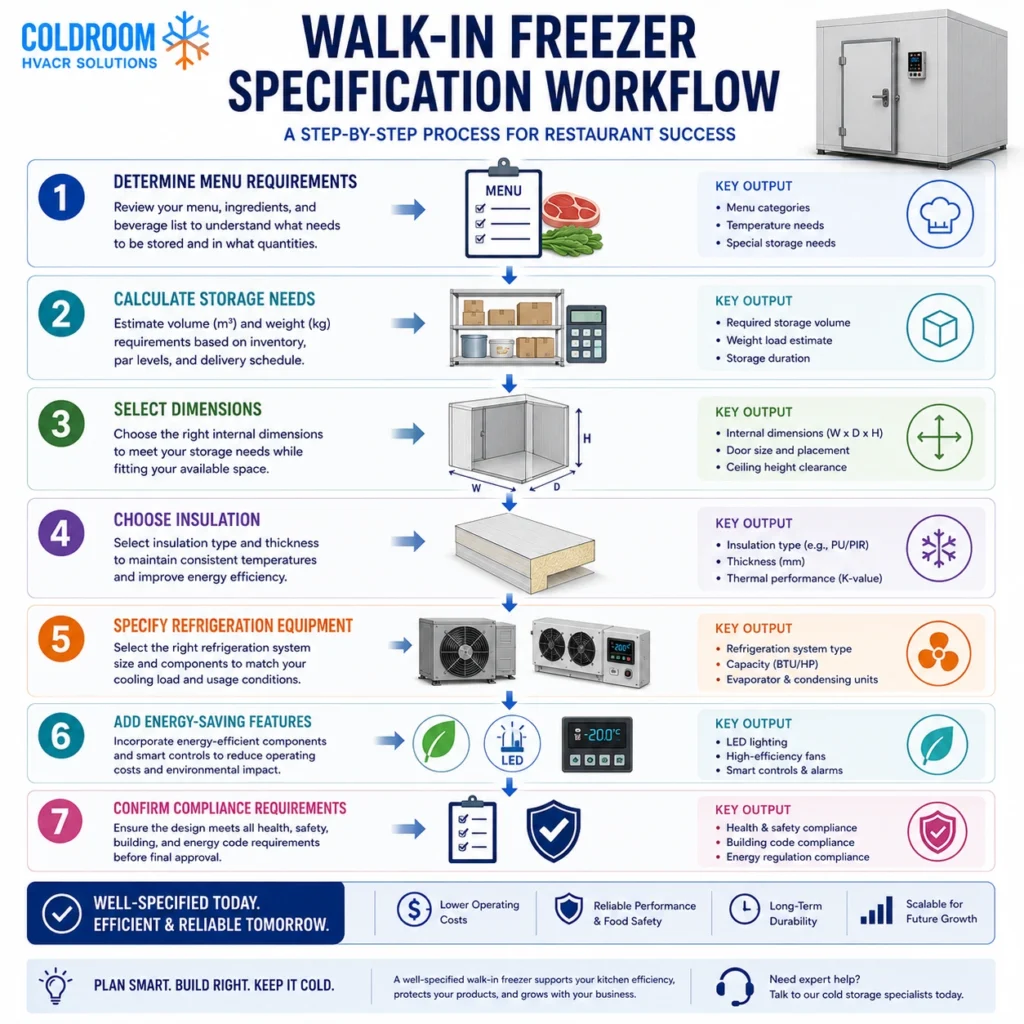
Step 7: Future-Proof Your Investment
The best restaurant walk in freezer installation is one that can adapt as your business evolves.
Ask these questions:
Will you add delivery services?
Will you expand menu items?
Could you open multiple locations?
Can the system accommodate higher inventory volumes?
Adding 20-30% spare capacity now is significantly cheaper than replacing the entire freezer later.
A scalable approach protects your investment over the next decade.
Comparison Table: Common Specification Mistakes
| Poor Specification Choice | Potential Problem | Better Alternative |
|---|---|---|
| Choosing the smallest unit | Storage shortages | Add 25–30% future capacity |
| Ignoring staff workflow | Kitchen bottlenecks | Design around movement patterns |
| Minimal insulation | Higher energy bills | High-performance insulated panels |
| Manual monitoring | Delayed fault detection | Digital monitoring systems |
| Ignoring compliance | Failed inspections | NSF-certified equipment |
Before You Approve Your Walk-In Freezer Installation, Ask Yourself This
Can your freezer comfortably handle your busiest trading day three years from now, not just your opening week?
That single question often separates restaurants that scale smoothly from those that face expensive upgrades sooner than expected.
What storage challenges are you currently facing while planning your new restaurant build?
Want a tailored recommendation or quick quote? Reach out today
Frequently Asked Questions (FAQs)
1. How much does a walk in freezer installation cost for a restaurant?
The cost of a walk in freezer installation for a restaurant typically ranges from £8,000 to £35,000+ in the UK, depending on the size, insulation type, refrigeration system, location, and additional features such as remote monitoring, shelving, and energy-efficient components. Larger restaurants and high-volume kitchens generally require bigger systems with higher installation costs.
2. What size walk in freezer does a new restaurant need?
The ideal size depends on your daily customer volume, menu complexity, inventory turnover, and delivery schedule. Small cafés may need a 6′ x 8′ freezer, while full-service restaurants often require 10′ x 12′ or larger. Experts recommend adding 20-30% extra capacity to accommodate future growth.
3. How long does restaurant walk in freezer installation take?
Most restaurant walk in freezer installation projects take between 3 and 10 working days, depending on the freezer size, site accessibility, electrical requirements, and commissioning needs. Larger commercial projects may take longer if additional building work is required.
4. What temperature should a restaurant walk in freezer be set to?
Most restaurant walk in freezers should be maintained at -18°C (0°F). Certain products, such as seafood or ice cream, may require colder temperatures ranging from -20°C to -23°C to preserve quality and food safety.
5. What factors should I consider before installing a walk in freezer in a new restaurant?
You should consider storage capacity, future business growth, kitchen workflow, delivery frequency, energy efficiency, insulation quality, compliance requirements, and available installation space before proceeding with a walk in freezer installation.
6. How energy efficient are modern walk in freezers?
Modern walk in freezers are significantly more energy efficient than older systems. Features such as LED lighting, high-performance insulation, automatic door closers, digital monitoring systems, and EC fan motors can substantially reduce operating costs and energy consumption.
7. What regulations apply to restaurant walk in freezer installation?
Restaurant walk in freezer installation must comply with food safety regulations, building regulations, electrical standards, and industry certifications such as NSF standards where applicable. Businesses should also ensure systems comply with local environmental and refrigeration gas regulations.
8. How often should a restaurant walk in freezer be serviced?
Commercial walk in freezers should be professionally serviced at least twice a year. Regular maintenance helps prevent breakdowns, improve energy efficiency, extend equipment lifespan, and maintain safe operating temperatures.
9. Can a walk in freezer be expanded in the future?
Yes. Many modular walk in freezer systems can be expanded later if additional storage is needed. However, planning for future growth during the initial installation is often more cost-effective than retrofitting an existing system.
10. How long does a commercial walk in freezer last?
A properly maintained commercial walk in freezer can last between 15 and 25 years. The lifespan depends on installation quality, usage levels, maintenance frequency, and the quality of components used.